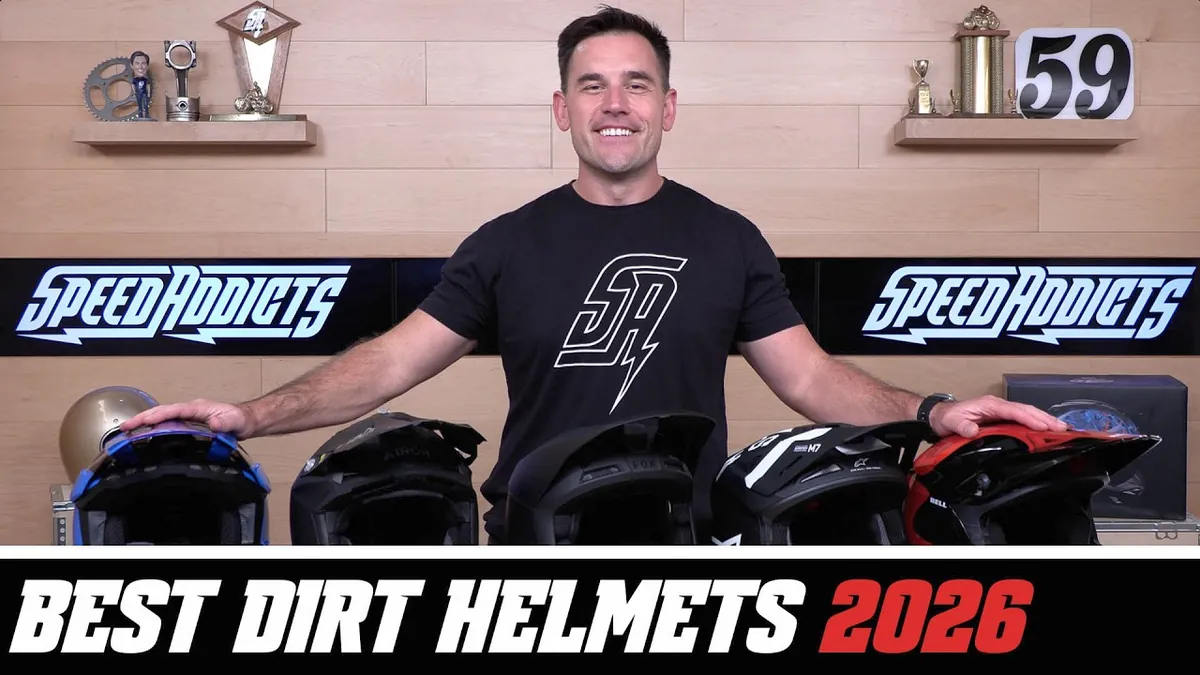
The 6D ATR-3 repeats as our top pick, but you don’t need $859 to protect your noggin in the dirt.
Summary: We picked our five favorite dirt helmets of 2026, from the $169.95 Fox V Core to the $859 6D ATR-3. The Bell MX-10 MIPS is the lightweight value play, the Alpinestars S-M7 and Airoh Aviator 3 cover premium, and the 6D ATR-3 is our top pick for the second year in a row.
Fall riding season is here, which means it’s time to stop wearing that roost-blasted lid from 2019. For this SpeedAddictsTV best-of, we lined up our five favorite dirt helmets on the market right now and worked our way up the price ladder: Fox V Core, Bell MX-10 MIPS, Alpinestars S-M7, Airoh Aviator 3 and 6D ATR-3. Every one of them is DOT certified, and every one of them has some kind of rotational-impact tech inside. Fit still matters more than anything on a spec sheet, so read our Best Motorcycle Helmet Fitment Guide before you buy online.
Best Budget Pick: Fox V Core — $169.95
The V Core is Fox’s entry-level dirt helmet, and it’s the one we reach for first when we fit 10-, 11- and 12-year-olds in the store. The reason is size. The V Core has a small, compact footprint, especially in the smaller sizes, so you’re not wearing more helmet than you need. That also makes it a hit with the electric-dirt-bike crowd. If your teenager is ripping a Sur-Ron and you don’t want a bobblehead, start here.
Fox uses an injection-molded polycarbonate and ABS shell, four shell sizes and five EPS sizes to cover XS through 2XL. It’s an intermediate-oval fit, and Mips is standard, which is not a given at this price. Fox lists nine intake and four exhaust vents and a visor designed to release in a crash. Claimed weight is 3.24 lb (1,470 g) in a size medium. Our extra-large looks a little big on camera because, well, it’s an extra-large.
Fox’s U.S. site lists the V Core at $169.95. We quoted $159 in the video, so budget the extra 10 bucks. It comes only in solid colors, and it sells out fast. When you see your size in stock, grab it.
Pros: Lowest price here, Mips standard, compact low-profile shell, four shell sizes, great for youth riders and e-bike riders.
Cons: Solid colors only, DOT only, frequently out of stock.
Best Lightweight Value: Bell MX-10 MIPS — $229.95
One notch up the price ladder is Bell’s entry-level MX-10 MIPS, which replaced the MX-9 MIPS. The thing we like most about it is the weight, or the lack of it. Bell claims 2.87 lb (1,300 g) for a size medium, and you notice it the second you pick it up. In our hands, small and medium sizes feel like they’re under 3 lb (1,361 g), and the larger sizes land right around 3 lb.
The styling borrows heavily from Bell’s top-tier Moto-10, including the Flying Bridge visor, which ditches the traditional center post and screw. Bell also keeps the graphics fresh with collabs like Fasthouse. The polycarbonate shell is DOT and ECE 22.06 certified, Mips is standard and the fit is intermediate oval and super comfortable. Speaker pockets sit behind the cheek pads, so running a comm system is no problem.
Solids are $229.95 on Bell’s U.S. site. Graphics are $254.95, and Fasthouse colorways are $274.95. Sizes run XS through 2XL.
Pros: Lightest claimed weight here, DOT and ECE 22.06, Mips, Moto-10 looks, speaker pockets, lots of graphics.
Cons: Polycarbonate shell, not as premium inside as the high-dollar lids.
Best Fitting Alpinestars: Alpinestars S-M7 — $459.95
Now we’re into premium territory. Want to look like Jett Lawrence? Here’s your chance. The S-M7 sits one notch under Alpinestars’ flagship S-M10, and it shows what the brand has learned from years of building off-road helmets. The multi-layer composite shell blends fiberglass, carbon and aramid fiber, and the build quality is very high-end.
The fit is the big story. Earlier Alpinestars dirt helmets felt hard inside, like a pro race helmet. That’s great for a 30-minute moto, less great for those of us who ride for fun all afternoon. The S-M7 splits the difference. It’s still race-ready, but it’s more comfortable, and it’s the best-fitting Alpinestars off-road helmet we’ve worn.
Ventilation is serious. Alpinestars counts 13 intakes and seven exhausts, including ports under the peak, gills in the chin bar and exhausts down low. Rotational protection comes from Alpinestars’ patented coating on the multi-density EPS liner paired with a special comfort-liner surface. There are three shell sizes for XS through 2XL, ear recesses for comms and a visor that releases in a crash. Alpinestars lists 2.95 lb (1,340 g) for a DOT size medium.
Solids are $459.95, and graphics are $519.95 on Alpinestars’ U.S. site. On a tighter budget? The SM3 is our honorable mention. It starts at $229.95 for solids, and you’d be happy to own one.
Pros: Comfortable race-ready fit, fiberglass, carbon and aramid shell, tons of airflow, ECE 22.06 and DOT, comms-ready, sharp graphics.
Cons: More than double the Bell’s price, only three shell sizes.
Best Interior: Airoh Aviator 3 — $699
Next stop: Italy. The Aviator 3 (listed as the Aviator III on Airoh’s U.S. site) is Airoh’s top off-road race helmet, and it’s a common sight in hard enduro. It looks like Lamborghini designed it, and we mean that as a compliment. Those top vents aren’t just for show. They let a lot of heat escape off your head, and Airoh lists 12 air intakes plus spoilers with integrated extractors.
Our favorite part is the interior. The perforated, microfiber-like lining is the best we’ve felt in a dirt helmet. It’s comfortable, high-end and a nice place to spend a long day. Airoh’s AMS2 EVO system uses multiple EPS densities to manage impact energy, and the cutaway in our store shows all the layers baked in. It’s an intermediate-oval fit. Four shell sizes cover XS through 2XL, and the U.S. helmet carries DOT and ECE certification.
The HPC Carbon composite shell starts at $699 for solids and $729 for graphics on Airoh’s U.S. site. Airoh claims 3.17 lb (1,440 g) for its lightest version. The full-carbon version is listed at $849, but every size was sold out when we checked. Airoh also includes a lot in the box: an action-cam mount, side bumpers, an extended peak, short and long nose covers, vent covers and a helmet bag. The warranty is five years.
Pros: Best interior here, exotic looks, strong airflow, four shell sizes, loaded accessory kit, five-year warranty.
Cons: Expensive, carbon version not in stock, heaviest claimed weight of the premium trio.
Our Top Pick for 2026: 6D ATR-3 — $859
It was our top pick for 2025, and nobody knocked it off. 6D cracked the code on a light, compact helmet that still has its secret sauce: the fifth-generation Omni-Directional Suspension (ODS) system for rotational and low-speed impact management. 6D changed the helmet-protection conversation back with the ATR-1, and the ATR-3 is the most refined version yet. It’s also what our host wears off-road.
The 3K carbon composite shell keeps claimed weight to 2.98 lb (1,350 g) for a size medium-large. The ATR-3 is DOT, ECE 22.06 and ACU certified. It was also one of the first helmets to pass the FIM’s new FRHPhe-02 standard, though U.S. helmets don’t carry the FIM label unless you ask for it. 6D sells a FIM-labeled solid for $924.95. Other details include speaker pockets, emergency-release cheek pads, a magnetic chin-strap clasp with titanium D-rings, a mud visor extension and a rebuild program, so a crash doesn’t automatically mean a new helmet.
The solid ATR-3 is $859 on 6D’s U.S. site. Graphics list from $794.95 to $899, and many were marked down when we checked. The big news is the new 6D MAX Goggle. It’s designed to fill the entire ATR-3 eyeport, so you get a much wider view and better dust sealing. It has interchangeable lenses, tear-offs and a vent setting. You can buy the MAX R Goggle on its own from $169.95, or get the ATR-3X for $995 with the goggle included, closable brow and mouthpiece vents, chin and neck curtains and a sun-visor extension. Pull the roost guard, snap in the goggle and go see more trail.
Pros: Proven ODS protection, sub-3 lb claimed weight, carbon shell, DOT, ECE 22.06 and ACU, rebuildable, MAX Goggle compatible, three-year warranty.
Cons: Priciest standard helmet here, FIM label only on request.
Dirt Helmet Spec Comparison
| Spec | Fox V Core | Bell MX-10 MIPS | Alpinestars S-M7 | Airoh Aviator 3 | 6D ATR-3 |
|---|---|---|---|---|---|
| Our take | Best Budget Pick | Best Lightweight Value | Best Fitting Alpinestars | Best Interior | Top Pick for 2026 |
| U.S. MSRP | $169.95 (solids only) | $229.95 solids; $254.95–$274.95 graphics | $459.95 solids; $519.95 graphics | $699 solids; $729 graphics; $849 carbon | $859 solid; $794.95–$899 graphics; $995 ATR-3X |
| Claimed weight | 3.24 lb (1,470 g), size M | 2.87 lb (1,300 g), size M | 2.95 lb (1,340 g), DOT size M | From 3.17 lb (1,440 g) | 2.98 lb (1,350 g), size M/L |
| Shell material | Polycarbonate and ABS | Polycarbonate | Fiberglass, carbon and aramid composite | HPC Carbon composite | 3K carbon composite |
| Shell sizes | 4 | N/A | 3 | 4 | N/A |
| Size range | XS–2XL | XS–2XL | XS–2XL | XS–2XL | XS–2XL |
| Certifications | DOT | DOT and ECE 22.06 | ECE 22.06 and DOT | DOT and ECE | DOT, ECE 22.06 and ACU (FIM label on request) |
| Impact tech | Mips | Mips | Multi-density EPS with rotational coating | AMS2 EVO multi-density EPS | 5th-gen ODS |
| Vents | 9 intake, 4 exhaust | N/A | 13 intake, 7 exhaust | 12 intakes plus extractors | N/A |
| Speaker pockets | N/A | Yes | Yes | N/A | Yes |
| Warranty | N/A | N/A | N/A | 5 years | 3-year limited |
Confused by all the safety stickers? Our DOT vs. ECE vs. Snell Explainer breaks it down in plain English.
Which Dirt Helmet Should You Buy?
Buy the Fox V Core if you want Mips and a compact shell for well under $200, especially for a youth or e-bike rider. Buy the Bell MX-10 MIPS if you want the lightest helmet for the money, plus ECE 22.06 and speaker pockets. Buy the Alpinestars S-M7 if you want a race-ready composite lid that’s comfortable enough for a full day. Buy the Airoh Aviator 3 if you want the most exciting look and the best interior here. Buy the 6D ATR-3 if you want our top pick, and add the MAX Goggle if you ride dusty, technical terrain. Already riding in an old one? Here’s When Should You Replace Your Motorcycle Helmet? Shopping for street lids too? See our Best Entry-Level Street Motorcycle Helmets of 2026. Better yet, come try them on at the Speed Addicts Superstore in Orange, California, and see the world’s greatest helmet wall.
Dirt Helmet FAQ
Which Dirt Helmet Is Our Top Pick for 2026?
The 6D ATR-3. It was also our top pick for 2025. It pairs 6D’s fifth-generation ODS system with a 3K carbon composite shell and a claimed 2.98 lb (1,350 g) weight in size medium-large.
What Is the Best Budget Dirt Helmet?
The Fox V Core, at $169.95. It has Mips, four shell sizes and a compact, low-profile shell. If you want ECE 22.06 too, step up to the $229.95 Bell MX-10 MIPS.
Which Dirt Helmet Is the Lightest?
On paper, the Bell MX-10 MIPS, at a claimed 2.87 lb (1,300 g) in size medium. The Alpinestars S-M7, at 2.95 lb (1,340 g), and the 6D ATR-3, at 2.98 lb (1,350 g), are also claimed under 3 lb.
Do These Helmets Have Rotational Impact Protection?
Yes. The Fox and Bell use Mips. Alpinestars uses a patented coating on the S-M7’s multi-density EPS liner, Airoh uses its AMS2 EVO system, and 6D uses its fifth-generation ODS.
Are These Dirt Helmets DOT Certified?
Yes. All five are DOT certified. The Bell MX-10 MIPS, Alpinestars S-M7 and 6D ATR-3 also carry ECE 22.06, and Airoh lists DOT and ECE for the Aviator 3.
Can You Run a Bluetooth Comm in a Dirt Helmet?
Yes, in most of these. The Bell MX-10 MIPS, Alpinestars S-M7 and 6D ATR-3 all have speaker pockets or ear recesses. For an off-road helmet with comms built in, see our Cardo Venture Off-Road Helmet story.
Want more Moto-1 in your Google results?
Add Moto-1 as a Preferred Source on Google