Gen 3 Öhlins and Brembos meet GPS, a key and a lower price
Summary: The 2026 Honda CBR1000RR-R Fireblade SP ($28,999) and Yamaha YZF-R1M ($27,899) both make about 160 hp stock. The Honda counters with Gen 3 Öhlins, Brembo brakes, sharper turn-in, better fuel economy and superior fit and finish. The Yamaha answers with less factory restriction, GPS, a keyed ignition, a smarter menu system and mid-corner grip.
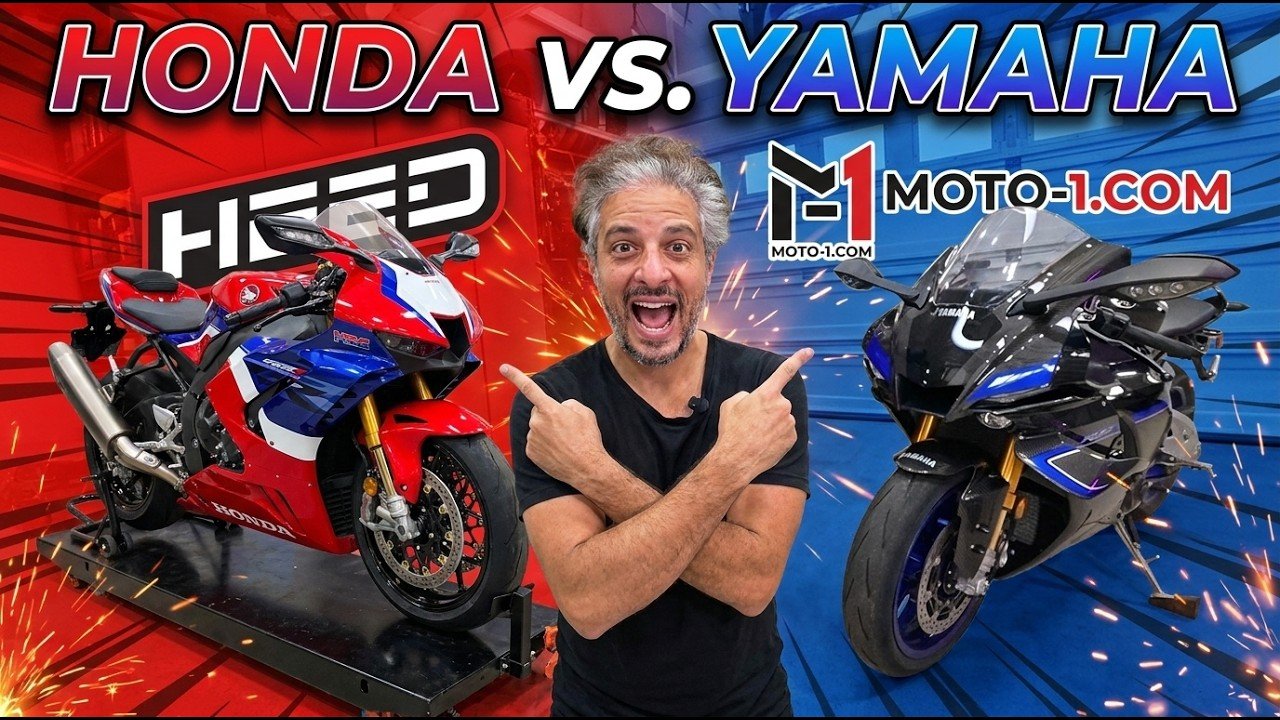
Hey everyone, good morning, and welcome to this episode of Garage Talk comparisons. The big dog 2026 Yamaha YZF-R1M is squaring off against another big dog, its nemesis from Kumamoto, Japan: Honda’s 2026 CBR1000RR-R Fireblade SP. These are the tip of the spear from the tuning fork brand and from Big Red’s superbike effort, and they’re lined up inside the garage to face off before we take them to the road and then the racetrack. Which one comes out on top? Let’s break it down.
Two Flagships, Two Different Ages
Let’s begin with the Yamaha, because it’s the elder statesman in this category. The YZF-R1M was last updated for the 2020 model year, so it’s six years old in its current wares. You’d never know it. Look how good this bike looks draped in full carbon-fiber bodywork. The MotoGP-inspired winglets arrived a couple of years ago, but everything else is the same.
The Honda wears very aerodynamic bodywork with much more mellow wings. It still has wings, just subtler ones. This generation of Fireblade SP arrived as a 2021 model, and it got a big, big update for 2025 with throttle response, riding-position, Brembo and Öhlins upgrades. It doesn’t look like Honda did much, but it did a whole lot. For the deep dive, check out our 2026 Honda CBR1000RR-R Fireblade SP Garage Talk, and tune into the @adamwaheed Instagram for our Top 5 vertical videos on the 2025 bike. You’ll find quick nuggets there that you won’t find anywhere else on the interwebs.
Side by side, the R1M has more of a wide-body stance to my eye, even though Honda’s tape measure says the Fireblade is the wider bike at 29.6 inches versus 27.2.
Crossplane CP4 vs. Conventional Screamer
Both bikes are powered by liquid-cooled inline-fours with dual overhead camshafts and 16-valve cylinder heads, but they’re very different animals. Yamaha’s 998cc CP4 uses a crossplane crank with an uneven firing order, so it feels like a hybrid between an inline-four and a V-twin. Honda’s 999.9cc engine uses a conventional firing order. It’s a pure, high-revving screamer. They sound different, they feel different, and they have very different powerbands.
Stock power is roughly the same: right around 160 horsepower for both. The Honda, though, is much more electronically restricted than the Yamaha. In fairness, the Yamaha isn’t Euro 5 compliant, which is why it gets a much smaller muffler and one reason it isn’t sold as a road bike in Europe. The Honda is, and look at the difference in the exhaust. The Fireblade’s Akrapovič-developed can is so much bigger, and not in a good way. If you’re buying a bone-stock superbike in America and want the least restriction, the R1M is the bike. It’s still restricted, just a lot less than the Fireblade SP.
Fuel: The Screamer Sips
The R1M drinks from a 4.5-gallon tank and the CBR from a 4.4-gallon tank. Believe it or not, the Honda gets just over 40 mpg on the road, while we’re seeing around 36 mpg on the R1M. The conventional screamer layout is a lot easier on fuel than the uneven-firing crossplane. Those engines like to drink gas.
Frames and Swingarms
Both bikes roll on twin-spar aluminum frames with big, beefy aluminum swingarms. I like the R1M’s swingarm a little better. It looks cleaner, and that polished aluminum finish is tasty, where the Honda’s is big, braced and beefy. On the other hand, I like the CBR’s frame better. More of it is exposed, which looks great. The architecture is similar, the execution isn’t.
Öhlins Semi-Active: Gen 2 vs. Gen 3
Both bikes ride on Öhlins semi-active suspension. The R1M runs what I call Gen 2 hardware (Yamaha calls it Öhlins Electronic Racing Suspension). The NPX fork and shock automatically adjust compression and rebound damping in real time based on vehicle load and rider input, while spring preload on the shock still gets set the old-fashioned way.
The Honda has the newer Gen 3 Öhlins system, with a 43mm NPX fork and TTX36 shock that do a finer job of making adjustments while you’re on the road. Preload is manual here too, with a handy adjuster on the shock. Honda adds a clevis that lets you raise or lower the shock length, which the R1M doesn’t have. That gives the Fireblade a little more chassis adjustability.
Brakes: Advics vs. Brembo Stylema R
Yamaha sticks with its tried-and-true Advics radial-mount four-piston calipers on 320mm discs, fed by a Nissin master cylinder. Those brakes are the R1M’s weak link. The Honda gets Brembo Stylema R calipers on 330mm discs with a Brembo master cylinder. Both bikes have IMU-powered cornering ABS. Yamaha calls its version Brake Control, but that’s what it is.
Keys, GPS and the Dash
The R1M gets integrated GPS through Yamaha’s Communication Control Unit, which logs lap times and course maps. The Honda doesn’t have that. Power up the R1M and you do it with a keyed ignition. Good job, Yamaha. We love keyed ignitions. And that huge ram-air intake still feeds a monster of a 998cc engine.
The Fireblade SP has a mechanical key, but it only opens the fuel tank. To power the bike on, the Smart Key fob has to be in proximity, and there’s no place to put it on the bike. How odd is that? Instead of an ignition key, there’s a strange switch on the left side that starts the power-up sequence.
The TFT dashes feel very similar in actual size (Honda’s is 5 inches, Yamaha’s 4.2), but the CBR’s menu navigation and user interface are much, much lower quality. The R1M’s menu system is way more logical to get into and make adjustments, which we really like. The Honda’s interface is more convoluted, with small buttons, and neither bike’s switchgear is backlit. Even though the R1M’s electronics package dates back to the 2015 model, it’s the clear winner on user interface and electronics as a whole, in our opinion. That’s pretty crazy.
Gearbox and Clutch
Both bikes get slipper clutches and six-speed transmissions with quickshifters. The Yamaha’s gearing is a tad lower overall than the Honda’s. Both have crazy tall first gears, which you want when you’re racing people on the freeway… I mean, on the racetrack. Ha ha.
Weight and Handling: Flickable vs. Glued
The CBR weighs 445 pounds with a full tank, versus 452 pounds wet for the Yamaha. So even though the R1M rolls on cast magnesium wheels and the Honda uses conventional cast aluminum wheels, the Yamaha is about seven pounds heavier.
You’d be blown away by how agile the Honda is, especially on turn-in. How flickable it is during turn-in is one of this CBR’s strongest attributes. Then you’d be amazed at how planted the Yamaha feels mid-corner. That’s not saying the Honda doesn’t feel planted, but the R1M is just glued to the ground mid-corner. They’re very different-handling motorcycles, and apart from turn-in, I wouldn’t say you really feel that seven-pound difference.
Bridgestone RS12 Rubber for Head 2 Head
Both bikes wear Bridgestone’s new Battlax Racing Street RS12, a high-performance street and track-day tire. We fitted them for our Head 2 Head series, which we’ve already filmed with Red Bull freestyle street rider Aaron Colton. Those episodes publish in November, so stay tuned.
Verdict: Is the Honda Worth $1,100 More?
The YZF-R1M is priced at $27,899, and the Fireblade SP is $28,999, so the Honda costs $1,100 more. Both carry a $775 destination charge. Is the Honda worth it? We’re about to take these bikes out on the road and the track to find out, and I already have a hankering suspicion of which one will be better.
For that extra grand, we have to hand it to Honda: the fit and finish on the Fireblade SP is superb. That’s not saying the R1M isn’t awesome, because it totally is, but the Honda squeaks out the Yamaha overall. Either way, these are two very high-quality, Japanese-made superbikes.
Enough of us yapping. It’s time to swing a leg over these bikes and declare a winner. Until then, catch our 2026 Yamaha YZF-R1M Real MC Commute and 2026 Honda CBR1000RR-R Fireblade SP Commute Review, see how BMW’s take on the formula fared in our 2025 BMW S1000RR Real MC Commute, and browse more motorcycle shootouts and comparisons. Sound off in the comments on YouTube and tell us which bike we should test next.
2026 Honda CBR1000RR-R Fireblade SP vs. Yamaha YZF-R1M Specifications
| Spec | 2026 Honda CBR1000RR-R Fireblade SP | 2026 Yamaha YZF-R1M |
|---|---|---|
| U.S. MSRP | $28,999 plus $775 destination ($29,774 total) | $27,899 plus $775 destination ($28,674 total) |
| Warranty | Transferable, one-year limited warranty; HondaCare Protection Plan available | One-year limited factory warranty |
| Engine | 999.9cc liquid-cooled inline-four, DOHC, 4 valves per cylinder, conventional firing order | 998cc liquid-cooled inline-four, DOHC, 4 valves per cylinder, crossplane crankshaft (CP4) |
| Bore x stroke | 81.0mm x 48.5mm | 79.0mm x 50.9mm |
| Compression ratio | 13.6:1 | 13.0:1 |
| Fuel delivery | PGM-FI fuel injection, 52mm throttle bodies, throttle-by-wire | Fuel injection with YCC-T ride-by-wire and YCC-I variable intake |
| Transmission | 6-speed, multiplate wet clutch, three-level quick shifter | 6-speed, assist and slipper clutch, Quick Shift System (up and down) |
| Final drive | #525 chain, 16/44 | Chain |
| Electronics | Bosch 6-axis IMU; 5 power levels; Honda Selectable Torque Control; Wheelie Control; 3-level Engine Brake; Start Mode; cornering ABS (Standard, Track, Race); electronic steering damper | 6-axis IMU; 4 power modes; lean-sensitive traction control; 4-level slide control; 4-level lift control; 3-level launch control; 3-level Engine Brake Management; lean-sensitive Brake Control with ABS |
| GPS data logging | No | Yes (Communication Control Unit with lap timing and course mapping) |
| Ignition | Honda Smart Key (keyless); key opens the fuel cap | Keyed ignition |
| Frame / swingarm | Aluminum twin-spar / 24.5-in braced aluminum swingarm | Aluminum Deltabox / polished aluminum swingarm |
| Front suspension | 43mm Öhlins NPX fork, Smart Electronic Control (S-EC3); 4.9 in travel | 43mm Öhlins Electronic Racing Suspension NPX fork, fully adjustable; 4.7 in travel |
| Rear suspension | Pro-Link, Öhlins TTX36 shock with S-EC3; 5.6 in travel | Öhlins Electronic Racing Suspension shock, fully adjustable; 4.7 in travel |
| Front brakes | Dual 330mm discs, radial-mount Brembo Stylema R four-piston calipers, Brembo master cylinder; ABS | Dual 320mm discs, radial-mount Advics four-piston calipers, Nissin master cylinder; Brake Control and ABS |
| Rear brake | 220mm disc, Brembo caliper; ABS | 220mm disc; Brake Control and ABS |
| Wheels | 17-in five-spoke cast aluminum | 17-in 10-spoke cast magnesium |
| Tire sizes (F/R) | 120/70ZR-17 / 200/55ZR-17 | 120/70ZR17 / 200/55ZR17 (Bridgestone Battlax Racing Street RS11 stock) |
| Test tires | Bridgestone Battlax Racing Street RS12 | Bridgestone Battlax Racing Street RS12 |
| Rake / trail | 24.0° / 4.0 in | 24.0° / 4.0 in |
| Wheelbase | 57.2 in | 55.3 in |
| Seat height | 32.7 in | 33.9 in |
| Ground clearance | 5.1 in | 5.1 in |
| L x W x H | 82.9 x 29.6 x 45.0 in | 80.9 x 27.2 x 45.9 in |
| Weight (full tank) | 445 lb curb | 452 lb wet |
| Fuel capacity | 4.4 gal | 4.5 gal |
| Our fuel economy | Just over 40 mpg | About 36 mpg |
| Display | 5-in full-color TFT | 4.2-in full-color TFT |
| Exhaust | Titanium muffler developed with Akrapovič | Compact stock muffler |
| Color | Grand Prix Red | Carbon Fiber |
| Built in | Kumamoto, Japan | Japan |
Fireblade SP vs. YZF-R1M FAQ
Which costs more, the Fireblade SP or the YZF-R1M?
The 2026 Honda CBR1000RR-R Fireblade SP is $28,999 MSRP and the 2026 Yamaha YZF-R1M is $27,899, so the Honda costs $1,100 more. Both add a $775 destination charge.
Which is more powerful in stock form?
Both make right around 160 hp stock, by Adam’s estimate. The Honda is much more electronically restricted from the factory, so the R1M is the less-restricted bike out of the box.
Which is lighter?
The Honda, at 445 pounds with a full tank versus 452 pounds wet for the Yamaha, despite the R1M’s magnesium wheels.
What’s the difference in suspension?
Both use Öhlins semi-active suspension. The Fireblade SP runs the newer third-generation system (S-EC3), while the R1M uses the earlier Öhlins Electronic Racing Suspension. The Honda also adds a shock-length adjuster for ride height.
Which gets better fuel economy?
The Honda. We see just over 40 mpg on the road from the Fireblade SP versus about 36 mpg from the R1M.
More Sportbike Coverage on Moto-1
- 2026 Honda CBR1000RR-R Fireblade SP Garage Talk: Bespoke and Muzzled
- 2026 Honda CBR1000RR-R Fireblade SP Commute Review
- 2026 Yamaha YZF-R1M Real MC Commute
- 2025 BMW S1000RR Real MC Commute: Plush Ride, Buzzy Heart
- 2027 Suzuki GSX-R1000R vs. 2026 Aprilia RSV4
- Head 2 Head Series Premiere
- Shootouts
- Sportbikes
- Honda Motorcycles
- Yamaha Motorcycles