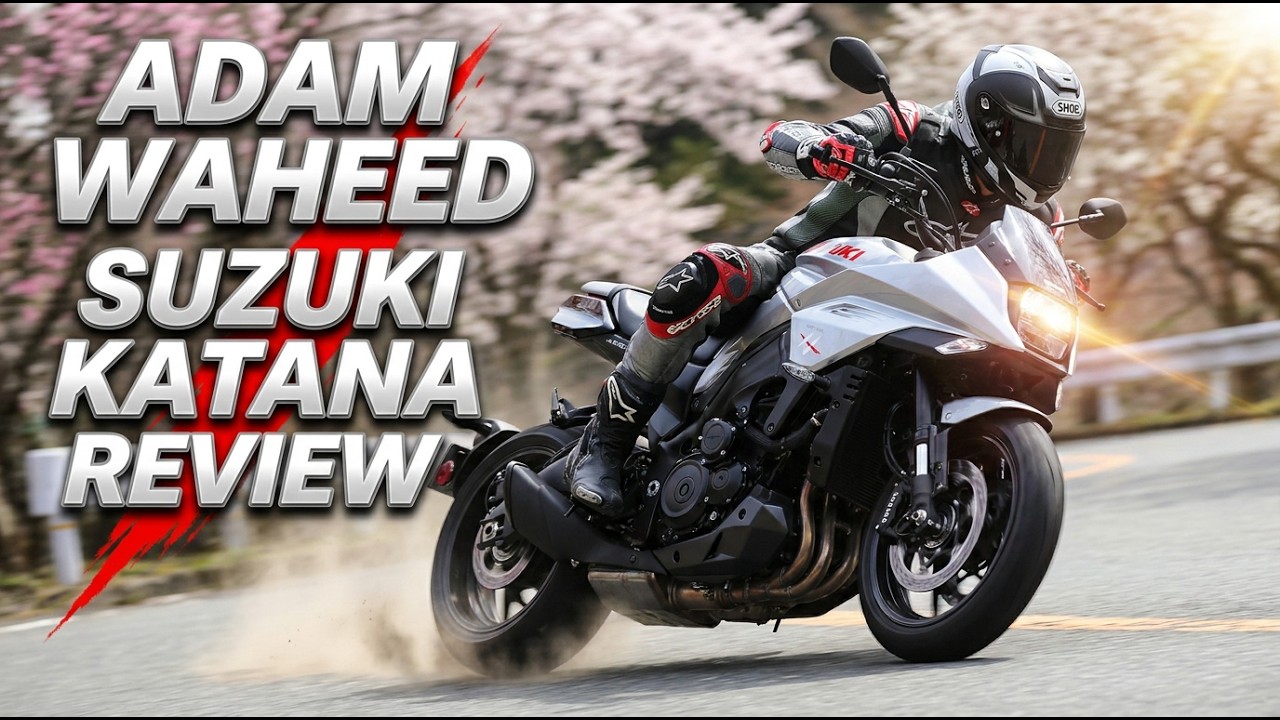

Retro-futuristic styling meets legendary 999cc sportbike muscle.
There is an old saying that a blade is only as sharp as the master who smiths it. In the case of the resurrected Suzuki Katana, the Japanese manufacturer decided to forge its latest street-slasher using a mix of heritage styling and tried-and-true mechanical muscle. To truly test this retro-futuristic machine, we traveled across the Pacific to the historic, winding mountain passes of Kyoto, Japan.
Suzuki literally shut down a private mountain toll road for this international press introduction, giving us an isolated, twisty playground to see if this modern throwback could live up to its legendary 1980s namesake. Drenched in misty, chilly Japanese mountain rain, the Katana didn’t just slice through the damp tarmac—it proved that nostalgia sounds a lot better when it is backed by a screaming inline-four engine.
Sticking to the Script: A Legendary Design Reborn
When the original Katana debuted at the Cologne Motorcycle Show in Germany back in 1980, it completely shattered the motorcycle design mold. Penned by legendary former BMW styling engineer Hans Muth, its aggressive, forward-swept lines raised eyebrows and captured wallets globally.
Decades later, Suzuki is pulling the cover off a machine that firmly sticks to that iconic script. The front end looks like something straight out of an ’80s sci-fi anime—beautifully retro yet sharply futuristic. The attention to detail is superb, from the classic rectangular LED headlight cowl to the nostalgic red Katana badging stamped along the flanks.
Climbing aboard, the cockpit treats the rider to an upright, comfortable handlebar position that strikes a perfect balance: it is narrow enough to slice through traffic but sporty enough to tackle a canyon. The instrument cluster features a monochrome digital panel heavily inspired by the modern GSX-R1000, complete with a wraparound digital tachometer that directly mimics the dual-analog, sweeping gauges of the original 1980s cluster.
The Soul of a Gixxer: Powertrain and Dynamics
Underneath that stunning bodywork lies a chassis and engine configuration shared with Suzuki’s contemporary open-class naked bike, the GSX-S1000. But the real magic is the heart of the beast. Suzuki chose to power the Katana with the legendary, long-stroke “K5” 999cc inline-four engine, originally sourced from the 2005 GSX-R1000.
Why use a two-decade-old engine architecture? Simple: long-stroke engines are torque monsters. On the street, you want immediate, heart-thumping torque that jumps off the line and pulls relentlessly out of slow corners. Even on our damp test road, dialing open the throttle rewarded us with a wonderfully robust engine character and a deep, acoustic exhaust note tuned in Suzuki’s own specialized engineering chambers.
Handling is shockingly nimble for a liter-class machine. The bike tips into tight corners effortlessly, belying its curb weight. While the chassis and suspension components match the GSX-S platform, Suzuki has spent years refining the damping parameters. The result is a highly compliant, forgiving ride quality that handily absorbs tarmac imperfections without any unsettling pitching under hard braking or heavy throttle.
To keep the power planted in the chilly Kyoto rain, the Katana comes shod with Dunlop’s Roadsport 2 urban sports tires. Designed specifically to build heat quickly in cold, wet conditions, they provided stellar feedback as we worked our way through the damp mountain sweepers.
Simple, Value-Conscious Technology
In an era where premium motorcycles are turning into moving computers, Suzuki keeps things brilliantly straightforward. There is no complex Inertial Measurement Unit (IMU), no cornering traction control, and no electronic quickshifter. Instead, you get a traditional, wheel-speed-sensor-driven traction control system with basic intervention levels and standard ABS that cannot be deactivated.
Suzuki has always strategically positioned itself as a value-conscious manufacturer. While European and domestic competitors push pricing deep into the fifteen-to-twenty-thousand-dollar territory, the Katana delivers raw, smile-inducing performance without forcing enthusiasts to empty their retirement funds. It is an honest, fast, and stunningly unique motorcycle that stands out in a sea of identical modern naked bikes.
For more insights into Suzuki’s standard lineup, check out our comprehensive guide to Suzuki street motorcycle models on Moto-1.com, or browse our long-term wrap-up of the Suzuki GSX-S1000 long-term test on Moto-1.com to see how this platform holds up over thousands of miles.
2020 Suzuki KatanaTechnical Specifications
| Feature | Specification |
| Engine Type | 999cc liquid-cooled inline 4-cylinder |
| Bore x Stroke | 73.4 mm x 59.0 mm |
| Fuel System | Fuel injection with SDTV (Suzuki Dual Throttle Valve) |
| Transmission | 6-speed constant mesh with slipper clutch |
| Front Suspension | KYB 43mm inverted fork, fully adjustable |
| Rear Suspension | Link-type single shock, link-type, adjustable rebound and preload |
| Front Brakes | Brembo 4-piston calipers, dual 310mm floating discs, ABS |
| Rear Brakes | Nissin 1-piston caliper, single 250mm disc, ABS |
| Tires (Front / Rear) | Dunlop Roadsport 2 (120/70ZR17 / 190/50ZR17) |
| U.S. MSRP | Approximately $13,499 USD |
| Warranty | 1-Year limited warranty (United States) |