Soft DDC, big vibes and 35.6 mpg on the freeway
Summary: The 2025 BMW S1000RR is one of the most street-friendly liter-class superbikes you can buy. With its Dynamic Damping Control semi-active suspension in the softest settings, it glides over freeway bumps. Roomy ergonomics, cruise control, strong Nissin brakes and 35.6 mpg on our ride help, but the 999cc inline-four vibrates a lot.
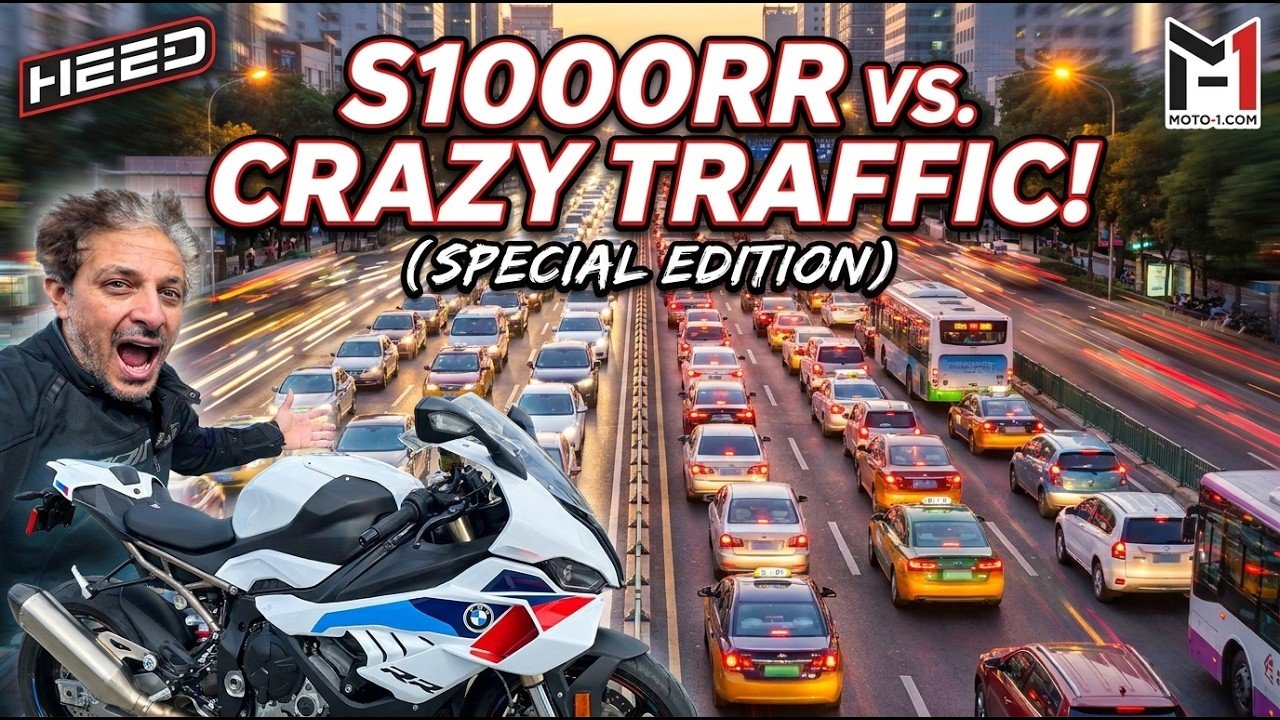
Good afternoon, folks, and welcome to Part 2 of our Real MC Commute special edition. This time we’re taking BMW’s 2025 S1000RR for a rip back up to the Moto Beach Classic in Huntington Beach, California, to do some more bike deliveries. That’s right, we’re clocked in today doing vehicle logistics. Real work, real traffic, real superbike.
You’ve seen this exact bike before. It’s the Light White / M Motorsport machine from our Mystery Bike Review, loaded with the M carbon-fiber wheels, the blue anodized Nissin calipers, and billet clutch and brake levers with a lever guard. That first video didn’t turn out quite as good as we wanted, so we’re doing more content on it to get things a little more dialed. Bottom line: this is BMW’s near-top-of-the-range liter-class superbike, and it’s one of my favorite street bikes. BMW lists the 2025 S 1000 RR at $18,995 plus $695 destination. Loaded up like ours with the M Package, Premium Package, M Carbon wheels and billet bits, mine came to $28,065 as tested against that $18,995 base.
Brought to You by Best Professional Marketing
Today’s ride happened because of our day job. We hauled a load of bikes for CFMoto to the Moto Beach Classic, and the S1000RR got to stretch its legs on the same trip. Yep, we’re now in the motorcycle delivery and vehicle logistics business, on top of the video, content, SEO and launch support Best Professional Marketing already provides to motorcycle and powersports brands. If you need bikes moved, or your brand needs a team that actually rides, surf on over to bestprofessionalmarketing.com and we’ll help you out.
Shark Gills and a Symmetrical Stare
The looks are classic Double R. The shark-gill bodywork is still there, and the headlights went symmetrical a few model years back, so no more winking face. Flip up the mechanical key, thumb the starter and watch the TFT run its start-up sequence. Ooh, listen to that thing. We were parked on a slight hill, and Hill Start Control automatically holds the rear brake so the bike is easier to launch away from a stop. Release the cable-actuated clutch and away we go. That clutch is so well weighted: it has some resistance, in a good way, and feels like a really high-quality part.
Ergonomics: Built for Real-Size Humans
This is a liter-class superbike, so it feels very sporty. The clip-ons are low and the seat is tall. Somehow, though, the ergonomics are less demanding than Yamaha’s YZF-R1 and R1M, which is kind of crazy. In the whole spectrum of literbikes, the S1000RR is one of the more comfortable ones out there.
A lot of the folks in Germany who engineered this bike actually ride motorcycles, and they built something they could fit on. Germans are generally taller than average, a little like us, so this bike works for real-size humans, including this 6-foot, 190-pound test rider. Our bike wears an optional, somewhat more comfortable seat, and after a good number of miles it’s pretty dang comfortable for a superbike.
The big bubbled windscreen does a good job of putting air up and over the rider, just like the YZF-R1M we rode in our last Real MC Commute. The fairing is wide, though maybe not quite as wide as the R1M’s. Ducati and Aprilia are making their bikes really wide, so the BMW splits the difference between the modern wide-body look and narrow-body bikes like the GSX-R1000R. All in all, it’s an accommodating riding position for a liter-class superbike.
The 999cc Inline-Four: Muzzled, Raw and Fun
Power comes from a 999cc inline-four with dual overhead camshafts and a 16-valve cylinder head. BMW quotes 205 hp at the crank, but in stock U.S. trim I’d put it right around 160-ish horsepower. Back when these bikes first came out, they made about 185 hp at the tire. Now they’re severely electronically limited from the factory. Our bike has BMW’s torque-optimized map, which gives you full torque at the expense of full horsepower; BMW also lets you switch to full horsepower without full torque. Our answer would be an ECU reflash, and we’ll dig into that more in a future S1000RR deep dive on Moto-1.
Even muzzled, this engine is raw and visceral in a good way. These engines vibrate a lot, and it’s nowhere near as smooth as the R1M’s crossplane. But that screaming, even-firing character is just such a hoot. Good thing the S1000RR is lean and mean enough to get through thick SoCal traffic, and thick isn’t the good kind here.
Quickshifter, Auto-Blip and a Race Shift Pattern
The six-speed gearbox gets an electronic quickshifter for clutchless, full-throttle upshifts plus auto-blip clutchless downshifts. BMW was a pioneer with the auto-blip downshift; I believe it was the first to put one on a production motorcycle. Years ago, in one of our superbike shootouts on the big track at Willow Springs, that feature let the BMW stay hooked up coming into corners and set it apart from the competition. Now everybody has one.
Our bike is set up with a reverse, race-style shift pattern: one up, five down, the opposite of a normal street bike. Someone must have flipped it. I actually like this pattern better. It just takes me a second to remember because I’m always jumping between bikes.
Electronics: Sophisticated, Slightly Clunky
The IMU-powered electronics package is very sophisticated, but the user interface is a little clunky. BMW had better menu navigation a couple of years ago. You still get the same great 6.5-inch color TFT and the same multi-wheel controller, though the wheel is starting to show its age. To set things up your way, you dive into the Race Pro modes; we built our custom settings in Race Pro 1, while the other modes hold BMW’s stock settings. That’s the cool thing about these bikes: they go from mild to wild with a few swipes of a button.
I also like that BMW gives you an off button that kills traction control, wheelie control and all that nonsense with one push. You can’t turn off ABS entirely, though. You can disable rear ABS but not the front, and I’d love the option to switch it all off.
DDC: A Superbike on a Pillow
This is the headline. Our bike rides on BMW’s Dynamic Damping Control, which is BMW speak for semi-active suspension. The fork and shock automatically adjust their valving in real time based on rider input and vehicle load. We loaded the least aggressive, softest and fastest damping maps, and oh my gosh, does it pay dividends on the road. This thing just glides over the bumps.
The R1M’s semi-active suspension helps it be less racy on the street, but this BMW is dang near a pussycat. Mind you, it’s still a high-performance superbike, so it’ll never be as comfortable as an S 1000 XR. But to have a literbike you can go racing on, then flip to the soft, fast damping mode and have it ride this plush, is just crazy. The S1000RR has always been one of my favorite street bikes because it’s so comfortable on the road and still so capable at the racetrack. The 2025 model continues that pedigree. Good job, BMW.
Freeway Life: Cruise Control, Smart Valves and Lots of Buzz
Time to put on cruise control and get where we’re going ASAP, rocket style. Our bike also has the optional tire pressure monitor, which read 34.1 psi front and 39.1 psi rear. I love that the tire valves are 90-degree stems, so you don’t have to fight the wheel spokes or brake rotors to check and adjust pressure. A lot of newer bikes have that feature; plenty of old-school carryover bikes still use straight stems, which are fine, just more annoying.
Two things worth mentioning after logging some miles. The final-drive gearing is on the low end of the spectrum, which means higher rpm at freeway speeds, and man, does this engine vibrate. I’ve always known BMW’s inline-fours buzz, but they really, really vibrate. Pair that with the lower gearing and a relatively short sixth gear, and you feel it at cruising speed. I still think it’s acceptable. The suspension is doing a lot of good work, the seat is comfortable and the ergonomics aren’t bad at all, so it’s still a really capable street bike.
It also doesn’t kick off a crazy amount of heat onto the rider, which I appreciated with the thermometer showing 92 degrees.
Brakes: Blue Nissins Bite Hard
The S1000RR uses triple-disc hydraulic brakes. Ours have blue anodized radial-mount calipers (BMW calls them M blue brake calipers; they are Nissins) and a Nissin master cylinder, plus BMW’s optional billet clutch and brake levers. The brakes on these bikes are always totally awesome, with excellent stopping power and a nice, responsive feel.
The IMU-powered cornering ABS lets you brake extremely hard, especially on its more aggressive map. The European bikes tend to run very aggressive ABS maps, so if you’re a maniac on the brakes, these are the bikes you want. It’s kind of crazy more bikes don’t come with Nissin calipers. You see Brembo everywhere, so seeing something different is cool. Nissin is OG Japanese craftsmanship, and if a caliper is machined from a billet piece of aluminum, I don’t care what logo is on it; it’s generally going to be rigid and won’t flex when you’re really pushing fluid through it.
The rear brake is nice and stout, with really good feel and response. I like that the pedal sits rather low, because I’m a big rear braker.
Billet Rearsets and Tons of Adjustment
Something I failed to mention in the last review: this bike has adjustable billet rearsets. You can change the peg height and move them fore or aft. I usually like the pegs in the lowest position and midway front to back, and now that I know they adjust, I’m going to try them one position lower. That’s what’s cool about the S1000RR in this trim: it has tremendous adjustment from the factory, and the electronics let you set the bike up without even turning a wrench. The rearsets need a wrench, but that’s OK. Maybe BMW can come out with semi-active footpeg adjustment? Hahaha. I don’t think so.
Fuel Economy and the Dash
The fuel gauge keeps tabs on the tank, and digging into the My Vehicle screen showed 35.6 mpg for our ride. That’s a little better than the YZF-R1M. In my experience, conventional-firing-order engines are a tad less thirsty at the pump than uneven-firing-order engines. I don’t really know why, but if you want max mpg, that’s the way to go.
I like that you can see all this info, along with the vehicle avatar; BMW was an early leader with that kind of display. But the multi-wheel controller is long in the tooth. I wish BMW would give it more tactile feel, and the switchgear needs to be backlit. Even KTM’s super-affordable bikes have backlit switchgear. Mildly backlit, BMW, not super bright.
Verdict: A Dang Good Street Superbike
That was a long day. We rode the YZF-R1M, we rode the S1000RR and we delivered some really neat bikes to the Moto Beach Classic for CFMoto. We came, we saw, we had a lot of fun.
I really like this S1000RR. It’s just a dang good liter-class superbike for street use. It looks badass, sounds badass, it’s relatively comfortable, it’s fast as heck, and it rides like a dream with the DDC in its super soft, fast setting. The engine vibrates a lot, but if you want high-spec liter-bike performance on the street, this loaded S1000RR, with that Motorsport colorway and those billet rearsets, checks all the boxes. BMW backs it with up to a 3-year/36,000-mile warranty. For more, check out our 2025 BMW S1000RR Review, our 2026 Aprilia RSV4 Factory vs. BMW S1000RR shootout and the rest of our BMW motorcycles coverage.
2025 BMW S1000RR Specifications
| Spec | 2025 BMW S 1000 RR |
|---|---|
| U.S. MSRP | $18,995 base MSRP + $695 destination; $28,065 as tested (M Package $4,995, Premium Package $2,590, TPM $295, M Billet Pack $495) |
| Warranty | Up to 3 years / 36,000 miles (BMW Motorrad USA); Ultimate Care Break-In Service included |
| Engine | 999cc liquid-cooled inline-four, DOHC, 4 valves per cylinder, BMW ShiftCam variable intake cam control |
| Bore x stroke | 80.0mm x 49.7mm |
| Compression ratio | 13.3:1 |
| Claimed horsepower | 205 hp @ 13,000 rpm (about 160 hp in stock U.S. trim, per video) |
| Claimed torque | 83 lb-ft @ 11,000 rpm |
| Transmission / final drive | 6-speed constant mesh; self-reinforcing anti-hopping clutch, mechanically operated; chain, 17/46 |
| Electronics | Riding Modes Pro (Rain, Road, Dynamic, Race, Race Pro 1-3); Dynamic Traction Control with slide control and adjustable wheelie function; ABS Pro and Race ABS; Dynamic Brake Control; MSR engine-drag torque control; Hill Start Control Pro; M Quick-Action Throttle; reverse shift pattern ready |
| Frame | Cast aluminum bridge-type frame, load-bearing engine; M Chassis Kit |
| Front suspension | 45mm inverted fork, adjustable preload, rebound and compression; 4.7 in travel (DDC semi-active damping with optional Premium Package, as tested) |
| Rear suspension | Aluminum swingarm, single shock, adjustable preload, rebound and compression; 4.6 in travel (DDC as tested) |
| Front brakes | Dual 320mm floating discs, radial-mount 4-piston fixed calipers (blue M calipers with M Package; Nissin) |
| Rear brake | 220mm disc |
| Wheels | Cast aluminum standard; M Carbon wheels as tested (M Package option) |
| Tires (F/R) | 120/70 ZR17 / 200/55 ZR17 |
| Rake / trail | 23.8° / 4.0 in |
| Wheelbase | 57.3 in |
| Seat height | 32.8 in |
| Wet weight | 436 lb ready to ride (426.6 lb with M Package) |
| Fuel capacity | 4.35 gal |
| Fuel economy | 35.6 mpg on our commute (dash readout, per video) |
| Display | 6.5-in color TFT with connectivity |
| Cruise control / heated grips / DDC | Optional Premium Package (fitted to our bike) |
| Tire pressure monitor | Optional (fitted to our bike) |
| Lighting | Full LED |
2025 BMW S1000RR FAQ
How much does the 2025 BMW S1000RR cost?
BMW Motorrad USA lists the 2025 S 1000 RR at $18,995 MSRP plus $695 destination. Options like the M Package, Premium Package and M Carbon wheels push our loaded test bike to $28,065 as tested. The 2026 model starts at $19,895 plus destination.
Is the BMW S1000RR comfortable enough to commute on?
Yes, by superbike standards. Its ergonomics are less demanding than Yamaha’s YZF-R1 and R1M, the windscreen moves air over the rider, and the DDC semi-active suspension rides plush in its softest settings. The engine does vibrate a lot at freeway speeds.
Does the S1000RR have cruise control?
Yes, as part of the optional Premium Package, which also adds DDC semi-active suspension and heated grips. Our test bike had it.
What fuel economy does the S1000RR get?
BMW doesn’t publish an mpg figure in its U.S. specs. Our bike’s dash showed 35.6 mpg on this freeway-heavy commute (per video), a little better than the 34 mpg we saw on the Yamaha YZF-R1M.
Can you turn off ABS on the S1000RR?
Not completely. Per the video, you can disable the rear ABS but not the front. A separate button switches off traction and wheelie control.
More Sportbike Coverage on Moto-1
- 2026 Yamaha YZF-R1M Real MC Commute
- 2025 BMW S1000RR Review
- 2026 BMW S1000RR Review
- 2026 Aprilia RSV4 Factory vs. BMW S1000RR
- 2026 Honda CBR1000RR-R Fireblade SP Commute Review
- 2027 Suzuki GSX-R1000R Real MC Commute
- Sportbikes
- BMW Motorcycles