An 11-year-old superbike that still bites hard
Summary: The 2026 Yamaha YZF-R1M is a $27,899 track-focused superbike that’s surprisingly livable on the street. Its 998cc crossplane CP4 engine has huge character, and the Öhlins semi-active suspension and mid-corner grip are excellent. The small TFT, missing cruise control, non-defeatable ABS and older Advics brakes show the platform’s age.
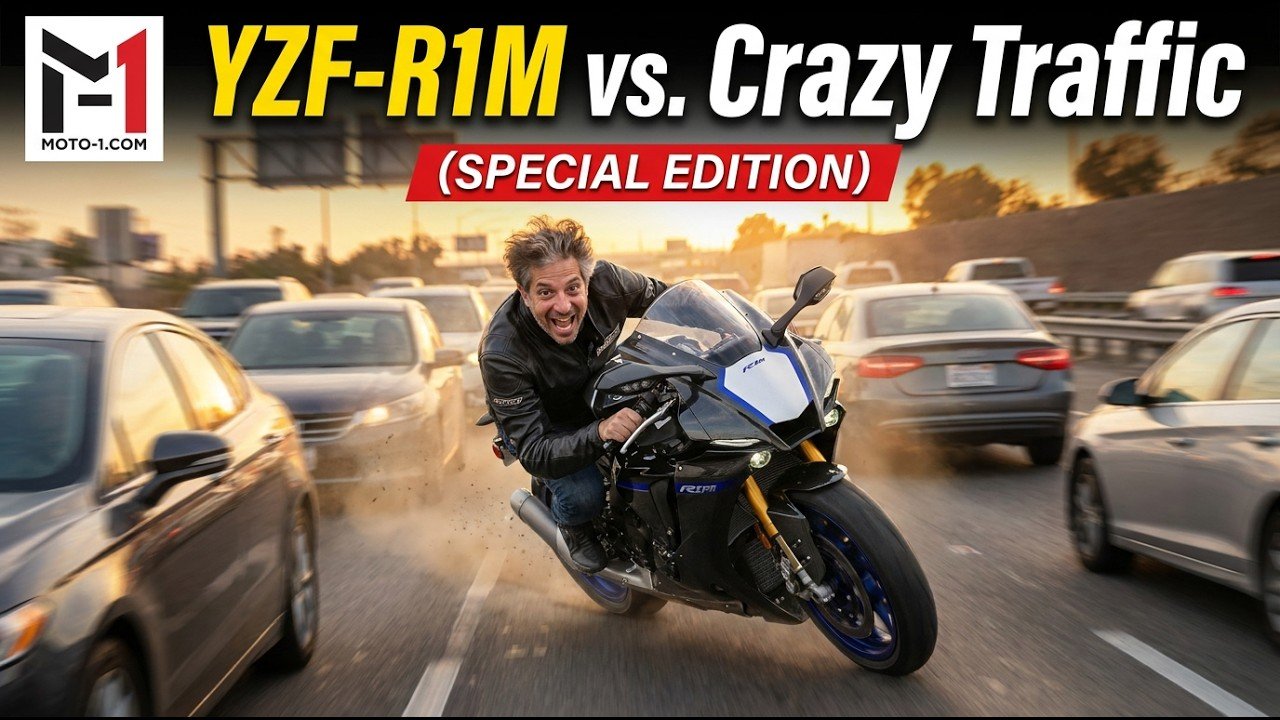
Good morning, folks, and welcome to a special edition of Real MC Commute, where we ride to work and get it done. No poser BS: real work, real money, real stuff. Today’s ride is Yamaha’s 2026 YZF-R1M, and we’re taking this bad mamajamba on a 50-mile run through Southern California freeway traffic to see how a bike built for the racetrack handles real life.
If you’re not familiar with it, the R1M has been in Yamaha’s lineup for a long time. It first came out for the 2015 model year, got a big update for 2020, and here it is in 2026 wares. The price has gone up too. Yamaha lists it at $27,899 plus a $775 destination charge, so call it just over 28 grand before tax and dealer fees. For a platform that’s 11 years old, that’s a lot of money. The good news is that this bike still makes a strong case for itself.
Brought to You by Best Professional Marketing
Today’s special edition happened because of our day job. We hauled a load of bikes for CFMoto up to the annual Moto Beach Classic in Huntington Beach, California, then rode the R1M home rather than burn more expensive diesel. That’s right, we’re now in the motorcycle delivery and transportation logistics business, on top of what Best Professional Marketing already does for motorcycle and powersports brands: filming and video, content marketing, SEO and GEO audits, and launch and media support, all led by people who actually ride. No fluff, just work that sells. If your brand needs any of that, or needs bikes moved, surf on over to bestprofessionalmarketing.com and book a strategy call.
What Makes the R1M an “M”
Start with the looks, because they’re half the reason anyone buys one. The R1M is dripping in carbon-fiber bodywork, and the MotoGP-inspired carbon winglets Yamaha added recently make it look even tastier. You get a brushed aluminum fuel tank, a polished aluminum swingarm and stock magnesium wheels. The giant ram-air intake sits up front between the slim LED running lights, with the headlights tucked underneath. It still looks super modern. This thing is just dripping in awesomeness.
The M also gets GPS data logging as standard. Yamaha’s Communication Control Unit records lap times, course maps and vehicle data that you can review in an app. And of course you get the Öhlins Electronic Racing Suspension, which is the big-ticket item. More on that in a minute.
Here’s the head-scratcher. The standard YZF-R1 got Brembo Stylema front calipers for 2025, but the R1M still uses an older-spec Advics radial-mount four-piston setup. So the cheaper R1 has the more modern brake caliper. That’s kind of crazy, but it is what it is.
Ergonomics: Racy, but Bearable
Sit on the R1M and there’s no mistaking what it is. The clip-ons are very low, the footpegs are very high, and the whole bike feels very racy. It’s not for slow people. I’m 6 feet tall and 192 pounds right now, and I wouldn’t say I’m totally comfortable. But the bike feels so high-performance that, in a way, it’s bearable. I’m also nostalgic about the R1 and R1M, which helps.
The broad front fairing, one of the 2020 changes, does a really good job of keeping air off the rider. The stock windscreen could be a little taller, but it creates a nice bubble for the wind to go over you. The seat is thinly padded, no lie, but there are definitely worse seats on sportbikes. For the 50- to 60-mile rides we do, it’s totally livable.
A couple of quirks. For whatever reason, this bike always sounds like it doesn’t quite want to start. It does start, and starting it in neutral helps. I run the TFT in dark mode, black background with white numbers, the way I like everything set up in my life.
The CP4 Crossplane Engine Is Still the Star
Power comes from the 998cc CP4 inline-four with dual overhead camshafts and liquid cooling. Yamaha USA doesn’t publish a horsepower figure, but in stock form I’d put it around 160 hp. Reflash the ECU, add a pipe, and you can push it to 190, 195, even close to 200, and you’re off to the races. Literally.
What makes the CP4 special is the crossplane crank and its uneven firing order. A conventional “screamer” inline-four from Honda, Kawasaki or Suzuki feels and sounds completely different. The Yamaha feels like a cross between a V-twin and an inline-four. You get V-twin-style power pulses and low-end and midrange torque, but you still get that whopping top-end character with a sound all its own. Yamaha switched to the crossplane in 2009, and I’m glad it stuck with it. It has a ton of low-end torque and makes it easy to slice through traffic.
It also has just the right amount of vibration. You definitely feel it through the pegs and clip-ons, but it’s the kind of vibration that makes riding a motorcycle fun. Yamaha has a tuning fork in its logo, and on this engine the vibration feels tuned in on purpose rather than left as an afterthought. If I could add one thing, it would be a Yoshimura Alpha T muffler so we could enjoy that CP4 sound even more.
Electronics: Ahead of Its Time, Still Effective
When this generation came out in 2015, Aprilia was the early electronics leader. I wouldn’t say Yamaha bested Aprilia, but the R1 brought a really sophisticated package, and the 2026 bike still uses the same basic system. It still works really well. The 2020 update brought a better ride-by-wire throttle. Mapping feels more one-to-one and more natural, closer to the feel of a cable throttle, though it still has a little synthetic feel like many ride-by-wire bikes.
The throttle feeds the six-axis IMU-powered traction control, slide control, lift (wheelie) control and lean-sensitive brake control. Yamaha doesn’t call it cornering ABS, but that’s what it is. You adjust everything on the fly with the mode button. On today’s ride I had it in the most powerful mode with traction control at its lowest setting.
Slide control is a moot point for street riders. It lets you power-drift off a corner and let the electronics sort it out, but you have to be a very skilled rider to make it work, and to trust it once the rear steps out. I’ve power-slid this bike, and if you commit, it does it. It’s really nice on the racetrack.
Engine Brake Management is adjustable too. I run more engine braking on the R1M than I would on, say, a Panigale V4, because the Yamaha has never had the best stopping power and the extra engine braking helps slow it down. On a bike with a telepathic front end and great brakes, I’d run less.
Öhlins Semi-Active Suspension: Mild to Wild
The R1M runs what I call Gen 2 Öhlins semi-active suspension (Yamaha calls it Öhlins Electronic Racing Suspension, or ERS). It’s not the latest generation, but it’s still dang good. I had it in its road mode, where it automatically adjusts damping based on rider input and load. Track modes just make it ride rougher on the street.
The trick is the manual mode. You can set fixed damping, dial out compression and rebound, and take out some preload. Do that, and you’d be surprised how smoothly this thing rides compared to the conventionally sprung YZF-R1. I wouldn’t call it a pussycat, but it’s a lot less racy. Then, at your favorite back road or the track, you dial it back in. That’s what’s so cool about semi-active systems: they go from mild to wild with the push of a button. Even without the softest settings, the freeway ride wasn’t bad. You definitely feel the bumps, and it’s a very rigid-feeling bike, but it’s nowhere near as unforgiving as I remember the non-semi-active R1 being. Would a newer-generation system be nicer? Sure. But for all intents and purposes, it’s OK.
The Dash Shows Its Age
The color TFT was awesome when it came out. Fast forward 11 years and it’s downright old, roughly iPhone 6-sized. It still packs in a lot of information, including the tach, gear position, GPS and the suspension load indicators that show when you’re loading the front and rear. Those are awesome. The way the information is displayed is still pretty good. I just wish there were more screen real estate to show it all.
Chassis: Heavy-Steering, Hooked Up
The R1M uses a racy twin-spar aluminum frame that’s made for going fast around corners, not commuting. Yamaha lists it at 452 pounds wet with a full tank. That’s not the lightest superbike out there, and not the heaviest. Side to side, it’s one of the heavier-steering bikes in the class. The CBR1000RR-R feels lighter, the Gixxer feels a bit lighter, the Panigale certainly feels lighter, and the Aprilia RSV4 is probably about the same. The magnesium wheels help.
Once it’s leaned over, though, the grip and feel are insane. Not many bikes are this hooked up mid-corner. Get on the throttle and the rear suspension bites hard into the pavement, so you can drive off corners really hard. The CP4’s connection to the rear tire pays dividends there, and you can really feel what the rear tire is doing. I live and die by feel. If a bike gives me lots of feel, I can ride it hard. This one does.
Freeway Life: Heat, Fuel and No Cruise Control
On the open freeway, the R1M isn’t terribly uncomfortable, thanks to that wide front end, the windscreen and the engine’s good vibes. It does throw off some heat, mostly onto your rear end and a little onto the inside of your legs. It’s nowhere near as bad as the 2009-2014 R1, which was my favorite wintertime sportbike for exactly that reason. In fairness, it was an unusually warm 87 degrees on our ride.
Yamaha, can we have some cruise control? It’s sadly missing. The bike already has ride-by-wire, so it has all the ingredients. We don’t need radar adaptive cruise, which is junk in our opinion. Standard electronic cruise would be awesome.
The CP4 drinks fuel, but we got 34 mpg on this ride, which isn’t awful. Ride it in a sporting manner and you’ll see around 29 or 30. Yamaha estimates 33 mpg. The mirrors deserve credit too. They have integrated LED turn signals and show you what’s behind you clearly, and the vibration isn’t enough to blur the view.
Brakes: The Weak Link, With a Plan
The R1M has triple-disc hydraulic brakes, with a Nissin radial-mount master cylinder feeding those Advics radial-mount four-piston calipers through stainless-steel lines. The lean-sensitive ABS has selectable modes, one with the cornering function and one without. But you can’t fully disable ABS, not even at the rear. There’s a workaround if you do a few things to trick the system, but there’s no legit off button. I’d love one like BMW’s S 1000 RR, where you hold a button and all the countermeasures come off. I like riding old-school manual style.
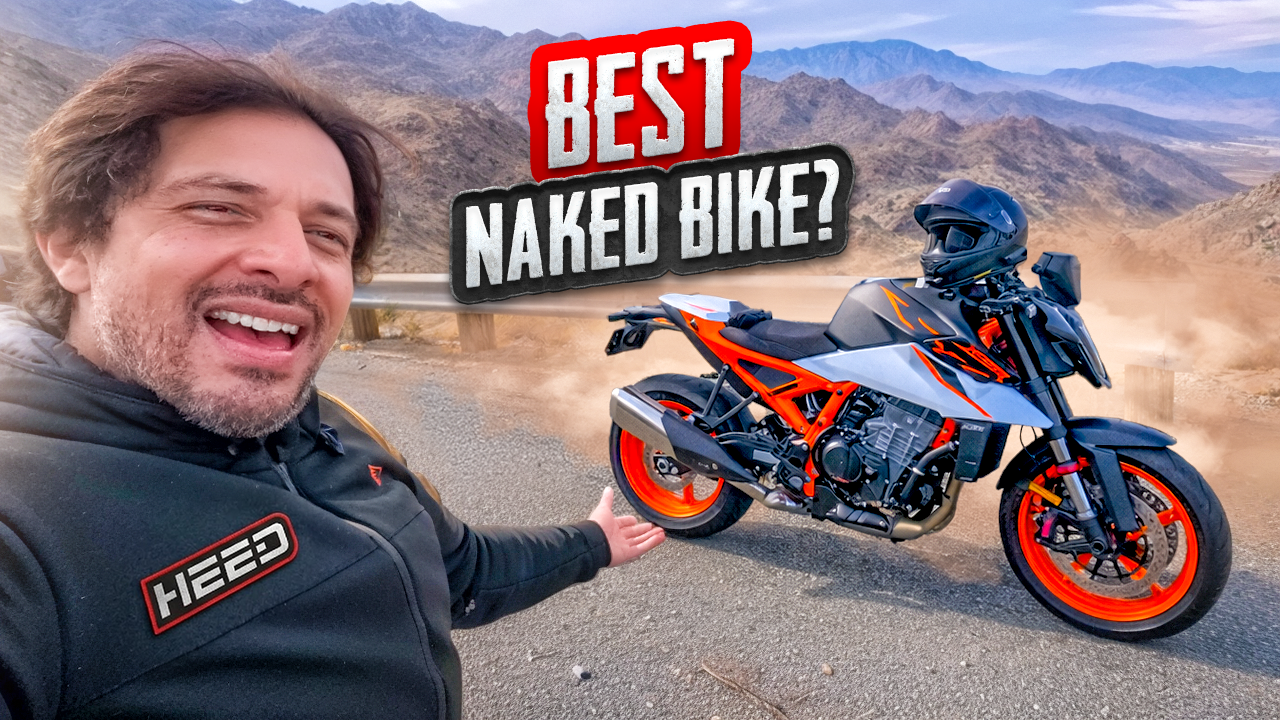
Historically, the brakes have been one of this bike’s weak links. On today’s ride, the recently bled system felt nice and sharp. The pads bite well and don’t feel wooden like the brakes on KTM’s 990 Duke R, which we rode recently. The problem is that these brakes tend to overheat, and I blame the ABS plumbing. There are lines running all over the place and too much fluid in the system. Clean up that plumbing, fit modern Brembo Stylemas, and we’d be off to the races. The rear brake is good: decently powerful, with good feel.
Verdict: 11 Years Old and Still a Hoot
That was an absolute hoot. It had been a long time since I’d ridden the R1M, and I was surprised at how capable it is on the road. Yes, it’s a little stiff and a little racy. But that engine makes tons of power where you want it, sounds super cool, doesn’t vibrate excessively and slices through traffic so well. Thirty-four mpg isn’t the best, but look at it: it looks like a race bike, dripping in carbon fiber. For a clearly track-focused literbike on an 11-year-old platform to look this good and perform this well, Yamaha did a great job.
The R1M is made in Japan and carries a one-year limited factory warranty in the U.S. Up next, we’ll put it in a shootout against another bike that’s yet to be named. Stay tuned for our Head 2 Head episode with Aaron Colton, too, where we pit the R1M against Honda’s CBR1000RR-R Fireblade SP. Until then, catch our 2026 Honda CBR1000RR-R Fireblade SP Commute Review and our 2027 Suzuki GSX-R1000R Real MC Commute. Sound off in the comments on YouTube and let us know what you think of these videos.
2026 Yamaha YZF-R1M Specifications
| Spec | 2026 Yamaha YZF-R1M |
|---|---|
| U.S. MSRP | $27,899 (Carbon Fiber) |
| Destination charge | $775 |
| Warranty | 1 year (limited factory warranty) |
| Engine | 998cc liquid-cooled inline-four, DOHC, 4 valves per cylinder, crossplane crankshaft (CP4) |
| Bore x stroke | 79.0mm x 50.9mm |
| Compression ratio | 13.0:1 |
| Horsepower | Not published by Yamaha USA (about 160 hp stock, per Adam) |
| Fuel delivery | Fuel injection with YCC-T ride-by-wire and YCC-I variable intake |
| Transmission / final drive | 6-speed with assist and slipper clutch; Quick Shift System (up and down); chain |
| Electronics | 6-axis IMU; 4-level power modes; lean-sensitive traction control; 4-level slide control; 4-level lift control; 3-level launch control; 3-level Engine Brake Management; lean-sensitive Brake Control with ABS |
| Data logging | Communication Control Unit with GPS lap timing, course mapping and app connectivity |
| Frame / swingarm | Aluminum Deltabox / polished aluminum |
| Front suspension | 43mm Öhlins Electronic Racing Suspension NPX fork, fully adjustable; 4.7 in travel |
| Rear suspension | Öhlins Electronic Racing Suspension single shock, fully adjustable; 4.7 in travel |
| Front brakes | Dual 320mm discs, radial-mount 4-piston calipers (Advics, per video), Nissin radial master cylinder (per video); Brake Control and ABS |
| Rear brake | 220mm disc; Brake Control and ABS |
| Wheels | 10-spoke cast magnesium |
| Tires (F/R) | Bridgestone Battlax Racing Street RS11; 120/70ZR17 / 200/55ZR17 |
| Rake / trail | 24.0° / 4.0 in |
| Wheelbase | 55.3 in |
| Seat height | 33.9 in |
| Ground clearance | 5.1 in |
| L x W x H | 80.9 x 27.2 x 45.9 in |
| Wet weight | 452 lb |
| Fuel capacity | 4.5 gal |
| Fuel economy | 33 mpg (Yamaha estimate); 34 mpg on our commute |
| Display | 4.2-in full-color TFT |
| Lighting | Full LED |
| Cruise control | Not available |
2026 Yamaha YZF-R1M FAQ
How much does the 2026 Yamaha YZF-R1M cost?
Yamaha lists the 2026 YZF-R1M at $27,899 MSRP in Carbon Fiber, plus a $775 destination charge. The standard 2026 YZF-R1 is $19,199.
How much horsepower does the YZF-R1M make?
Yamaha USA doesn’t publish a horsepower figure. Adam estimates the stock CP4 at around 160 hp and says an ECU reflash and exhaust can push it toward 190 hp or more.
Is the YZF-R1M comfortable enough to commute on?
For 50- to 60-mile rides, yes. The low clip-ons, high pegs and thin seat are racy, but the wide fairing blocks wind well. In manual mode, you can soften the Öhlins semi-active suspension for the street.
Does the 2026 YZF-R1M have cruise control?
No. Neither cruise control nor a full ABS-off mode is available. The lean-sensitive ABS has selectable modes, but it can’t be fully disabled, even at the rear.
What fuel economy does the YZF-R1M get?
Yamaha estimates 33 mpg. We saw 34 mpg on our freeway-heavy commute, and Adam expects around 29 to 30 mpg when ridden hard.
More Sportbike Coverage on Moto-1
- 2026 Honda CBR1000RR-R Fireblade SP Commute Review
- 2027 Suzuki GSX-R1000R Real MC Commute
- Yamaha YZF-R9 Real MC Commute
- Yamaha YZF-R7 Real MC Commute
- 2026 Aprilia RSV4 Factory vs. BMW S1000RR
- 2027 Ducati Panigale V4 Preview
- Sportbikes
- Yamaha Motorcycles