NiteRider’s five-model Lumina Moto helmet-light lineup runs $74.99 to $159.99, and the San Diego-area lighting company is bringing it to the SEMA Show in Las Vegas for the first time, Nov. 3–6, 2026.
Your motorcycle’s headlight is loyal, but it’s not psychic. It points wherever the handlebar points, which is great until the trail bends left or a deer auditions for your next crash video. NiteRider’s answer is a light on your head, too. The Poway, California, company has built lights for cyclists, divers and night surfers since 1989, and now it’s pushing harder into the motorcycle gear powersports with its Lumina Moto helmet lights and a growing off-road range. All of it will be in SEMA’s new Powersports, SxS and Lifestyle section in the West Hall at the Las Vegas Convention Center, booth 60227.
Why a Helmet Light on a Motorcycle?
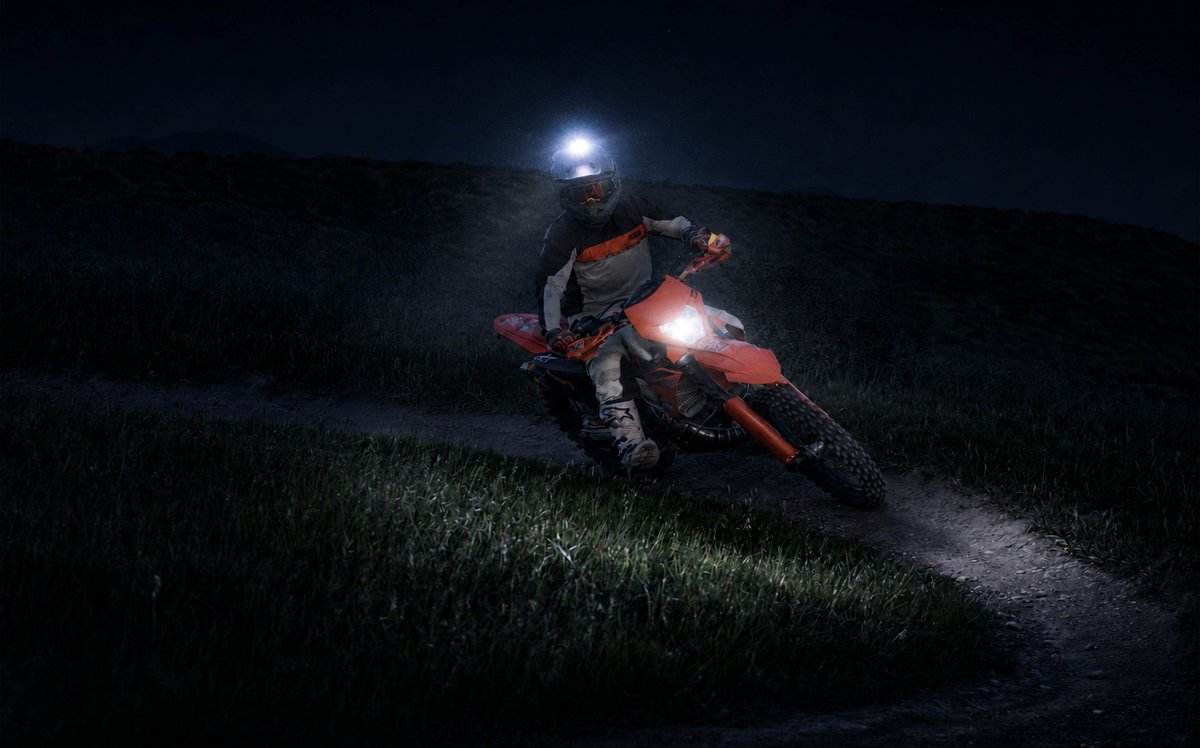
NiteRider President Drew Engelmann put the pitch simply: “NiteRider’s lighting is designed around the rider, not just the motorcycle. With a helmet-mounted light and self-contained battery, the light follows where you’re looking, rather than only where the bike is pointed, and there’s no separate battery pack or wires. It’s a simple way to add light where the rider needs it most.”
If you’ve ridden a tight trail at night, you get it. You look through a corner before you turn into it; your headlight doesn’t. A helmet light lights up the exit, the rut or the rock that wasn’t there in daylight.
The key detail on the Lumina Moto lights is that each one is self-contained. The battery lives in the light body, so there’s no cable running down the back of your helmet to a pack in your jersey or hydration bag. Each comes with the adhesive Lumina Stick-On Mount, charges via USB-C and is IP66 rated, so a muddy creek crossing shouldn’t ruin your evening (your boots are on their own).
The Lumina Moto Lineup
There are five lights, from a compact 950-lumen model to a 2,000-lumen dual-LED unit. Prices and specs come from NiteRider’s release and niterider.com; where they disagree, we list both.
Lumina Micro-Moto 950 ($74.99)
The entry point is the Micro-Moto 950, the lightest of the bunch. NiteRider’s release lists it at 140 grams, while the product page says 142 grams. Either way, it’s about 5 ounces. It tops out at 950 lumens in High mode for 2 hours. Medium (425 lumens) runs 5 hours, which is the “up to 5:00 hrs” figure in the release, and Low (200 lumens) stretches to 13 hours. The battery is a 1,800 mAh (6.66 Wh) lithium-ion pack. For $74.99, it’s the obvious “I didn’t know I needed this” upgrade for trail riders who get caught out late.
Lumina Boost-Moto 1250 ($99.99)
Step up to the Boost-Moto 1250 and you get a Boost mode of 1,250 lumens for 1 hour. High (850 lumens) runs 1.5 hours, Medium (380 lumens) runs 3.5 hours and Low (250 lumens) runs 6 hours. The battery grows to 2,600 mAh (9.62 Wh), and the light weighs 174 grams, or about 6.1 ounces. NiteRider pitches it as the light for riders who carry more speed in dark terrain. Translation: the sun went down, you didn’t slow down.
Lumina Pro-Moto 1400 ($139.99)
The Pro-Moto 1400 adds dedicated brighter (+) and dimmer (–) buttons, so you’re not scrolling through every mode while wearing winter gloves. Boost delivers 1,400 lumens for 55 minutes. High (950 lumens) runs 1.5 hours, Medium (500 lumens) runs 3 hours and Low (250 lumens) runs 7 hours. It uses a 3,000 mAh (11.10 Wh) battery and has a visual battery readout. NiteRider doesn’t list a weight for this one, so it’s N/A in our table.
Lumina Pro-Moto 1550 ($159.99)
This is the model NiteRider is putting in SEMA’s New Product Showcase, and it’s the most interesting one in the family. The Pro-Moto 1550 has NiteLink wireless connectivity built in. Pair it with the NiteLink Wireless Remote Control ($34.99, sold separately) on your handlebar and you can change modes without poking at your head. Boost puts out 1,550 lumens for 45 minutes. High (1,000 lumens) runs 1.5 hours, Medium (650 lumens) runs 3 hours and Low (250 lumens) runs 6 hours. It also has the brighter/dimmer buttons, an 8-step fuel gauge and the same 3,000 mAh (11.10 Wh) battery as the 1400. Weight isn’t listed.
Lumina Dual-Moto 2000 ($159.99)
The Dual-Moto 2000 costs the same as the Pro-Moto 1550, but it takes a different approach. It uses two LEDs and a wider beam, with a Boost mode of 2,000 lumens for 1 hour. High (1,800 lumens) runs 2.5 hours, Medium (950 lumens) runs 4.5 hours and Low (575 lumens) runs 8.5 hours. Credit the lineup’s biggest battery, a 6,000 mAh (22.2 Wh) cell. The tradeoff is weight. At 237 grams (about 8.4 ounces), it’s the heaviest Lumina Moto, though it’s still lighter than most of the bad decisions we’ve made on a trail at dusk.
So which $159.99 light? Want a bar remote, get the 1550. Want the most light and run time, get the Dual-Moto 2000.
Lumina Moto Specs and Prices
| Model | Price (USD) | Max Output | Max-Output Run Time | Medium Run Time | Low Run Time (site) | Release “Up To” Run Time | Battery | Weight | NiteLink |
|---|---|---|---|---|---|---|---|---|---|
| Lumina Micro-Moto 950 | $74.99 | 950 lm | 2:00 (High) | 5:00 (425 lm) | 13:00 (200 lm) | 5:00 | 1,800 mAh / 6.66 Wh | 140 g (release) / 142 g (site), approx. 5.0 oz | No |
| Lumina Boost-Moto 1250 | $99.99 | 1,250 lm | 1:00 (Boost) | 3:30 (380 lm) | 6:00 (250 lm) | 3:30 | 2,600 mAh / 9.62 Wh | 174 g (approx. 6.1 oz) | No |
| Lumina Pro-Moto 1400 | $139.99 | 1,400 lm | 0:55 (Boost) | 3:00 (500 lm) | 7:00 (250 lm) | 3:00 | 3,000 mAh / 11.10 Wh | N/A | No |
| Lumina Pro-Moto 1550 | $159.99 | 1,550 lm | 0:45 (Boost) | 3:00 (650 lm) | 6:00 (250 lm) | 3:00 | 3,000 mAh / 11.10 Wh | N/A | Yes (remote $34.99, sold separately) |
| Lumina Dual-Moto 2000 | $159.99 | 2,000 lm | 1:00 (Boost) | 4:30 (950 lm) | 8:30 (575 lm) | 4:30 | 6,000 mAh / 22.2 Wh | 237 g (approx. 8.4 oz) | No |
All five lights charge via USB-C, carry an IP66 rating and include the Lumina Stick-On Mount. Run times are hours:minutes. The press release’s “up to” figures match each light’s Medium mode, while the product pages list longer Low-mode times. Prices are from niterider.com as of Oct. 30, 2026.
The Off-Road and Vehicle Lighting Side
NiteRider is also bringing bigger vehicle-mounted hardware to Vegas. “NiteRider lights are designed and engineered here in the U.S. with features that come from understanding what riders need,” Engelmann said. “Our success in cycling and other enthusiast segments has shown us the power of extending the ride, and we see a big opportunity to deliver more purpose-built products and accessories for dirt bikes, ATVs, UTVs, snowmobiles, Jeeps and trucks.”
Here’s the rest of the powersports lineup headed to SEMA:
- ADV Lighting: These are hardwired auxiliary lights that run off the bike’s electrical system, so there’s no battery pack, and you control them from the handlebar. The ADV 4000 Set ($429.99) is rated at 4,000 lumens total, and the ADV 9000 Set ($549.99) at 9,000 lumens total. NiteRider’s press photos show the ADV lights on a Yamaha Ténéré 700, which is about as natural a home for them as we can think of.
- Pro MX Lighting: These are high-output helmet lights with external battery packs, built for fast, demanding off-road riding. The current Pro MX range on niterider.com runs from $219.99 for the Pro 2200 MX Hardwired to $489.99 for the Pro 4200 MX Enduro (8-Cell) with Stick-On Mount.
- Omega Blue 330 ($69.99) and BlueBomb 100 ($49.99): These rear-facing blue lights help riders behind you see you in dust and darkness. The Omega Blue 330 is rechargeable, makes 330 lumens, weighs 79 grams (about 2.8 ounces) and charges via Micro-USB. The BlueBomb 100 runs on two AAA batteries for up to 136 hours and weighs 82 grams (about 2.9 ounces). Both are for off-road use only.
- Corsair Off-Road Vehicle Lighting: Each Corsair is a six-LED aluminum lamp rated at 6,000 raw lumens. It draws 54 watts (4.5 amps at 12 volts) and works on 9 to 24 volts. The Corsair Solo is $269.99, and the two-lamp Corsair DUO is $499.99.
- Lightning Jeep Lighting ($424.99): This is a bumper-mounted pair of 6,000-raw-lumen lamps built for specific Jeep models. Not exactly moto, but plenty of dirt bikes ride to the trailhead behind one.
NiteRider tells buyers to check electrical capacity, wiring and local off-road-use rules before installing the vehicle lights, so don’t light up the freeway like a stadium.
Who Is NiteRider?
Tom and Veronica Carroll founded NiteRider in Southern California in 1989. It started by lighting nighttime surf sessions, then moved into cycling, scuba diving and industrial work. Today it’s based in Poway, north of San Diego, making headlights, taillights, helmet systems and vehicle-powered lighting.
Our Take
We’re fans of gear that solves a real problem without asking you to rewire your life, and a self-contained helmet light fits that bill. At $74.99, the Micro-Moto 950 costs less than a lot of tire changes, and it could save you from a long walk out of the woods after dark. The Pro-Moto 1550’s wireless remote is the clever bit. Changing modes from the bar beats pawing at your helmet on the move.
Some questions remain. We’d like to know how the Stick-On Mount holds up over months of trail abuse. We also want to see how these lights work next to helmet communicators and cameras that compete for the same shell space. If you’ve already got a comm unit on the side, like the setup in our Cardo Packtalk Edge install on the HJC i11, plan where everything goes before you peel any adhesive backing. We’d also like weights for the two Pro-Moto models, which NiteRider doesn’t list yet.
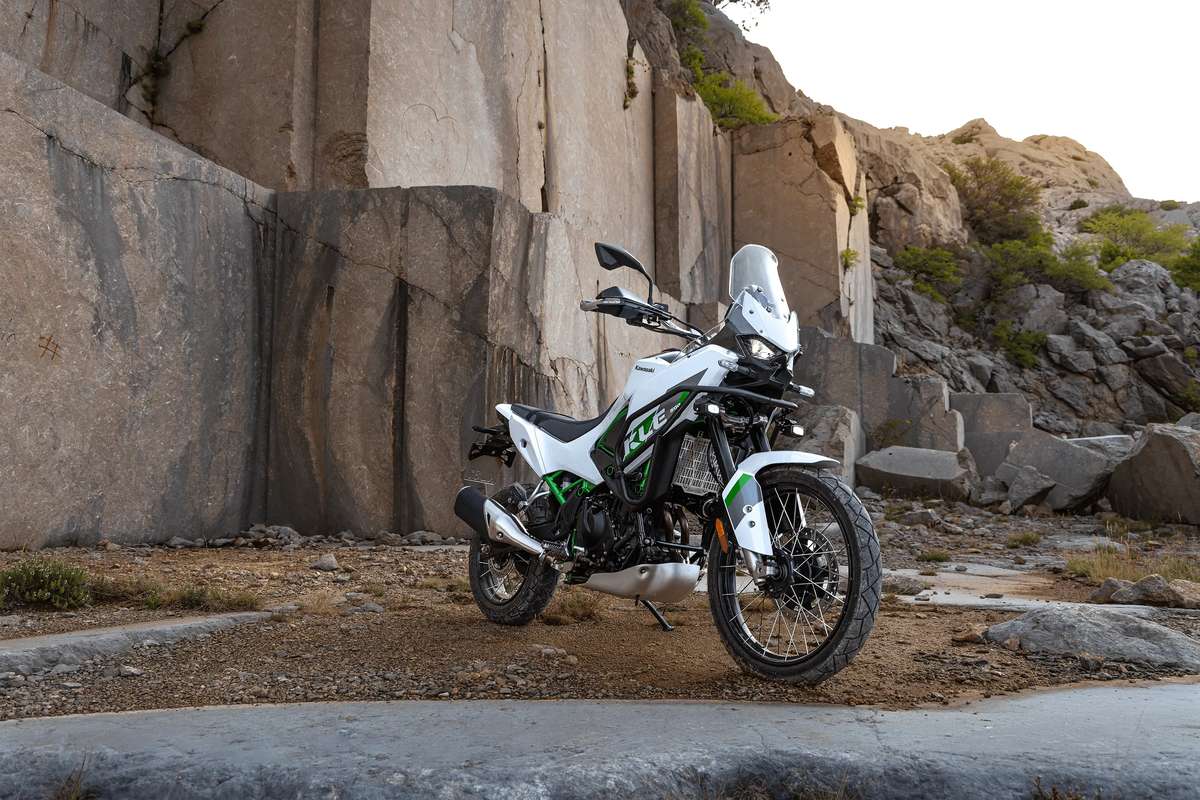
These lights should suit riders on adventure and dual-sport bikes like the ones in our 2027 Kawasaki KLR650 DF ABS Preview and our Yamaha Ténéré 700 World Raid Off-Road Review, because those rides tend to run past sunset. Bolt-on gadget fans should also check our RiderNav R7X Review.
If you’re at SEMA next week, NiteRider is in the West Hall’s Powersports, SxS and Lifestyle section at booth 60227, and the Pro-Moto 1550 will be in the New Product Showcase. Everyone else can find the Lumina Moto lights on niterider.com now.
FAQ
How much do NiteRider Lumina Moto helmet lights cost?
They run $74.99 to $159.99 on niterider.com. The NiteLink remote for the Pro-Moto 1550 is $34.99 extra.
Do the Lumina Moto lights need an external battery pack?
No. Every Lumina Moto light has a built-in lithium-ion battery and charges via USB-C. There are no wires running down your back. NiteRider’s separate Pro MX helmet lights do use external battery packs.
Which Lumina Moto light works with a handlebar remote?
Only the Lumina Pro-Moto 1550 has NiteLink wireless connectivity built in. It pairs with the NiteLink Wireless Remote Control, which mounts on the handlebar and costs $34.99, sold separately.
Are the Lumina Moto lights waterproof?
All five are rated IP66: dust-tight and protected against powerful water jets. Rain and creek splash, yes. Submarining, no.
When and where is NiteRider at the 2026 SEMA Show?
The 2026 SEMA Show runs Nov. 3–6 at the Las Vegas Convention Center. NiteRider is in the new Powersports, SxS and Lifestyle section in the West Hall, booth 60227.