Four legs, hydrogen power, aimed at 2035
Summary: Kawasaki brought a full-scale mock-up of CORLEO, its hydrogen-powered Robotic Multi-legged Vehicle, to EICMA 2026 in Milan. The four-legged personal mobility concept uses rider weight-shift controls and a series-hybrid hydrogen engine that generates electricity for its legs. Kawasaki is aiming for full commercialization around 2035. Price, weight and dimensions are N/A.
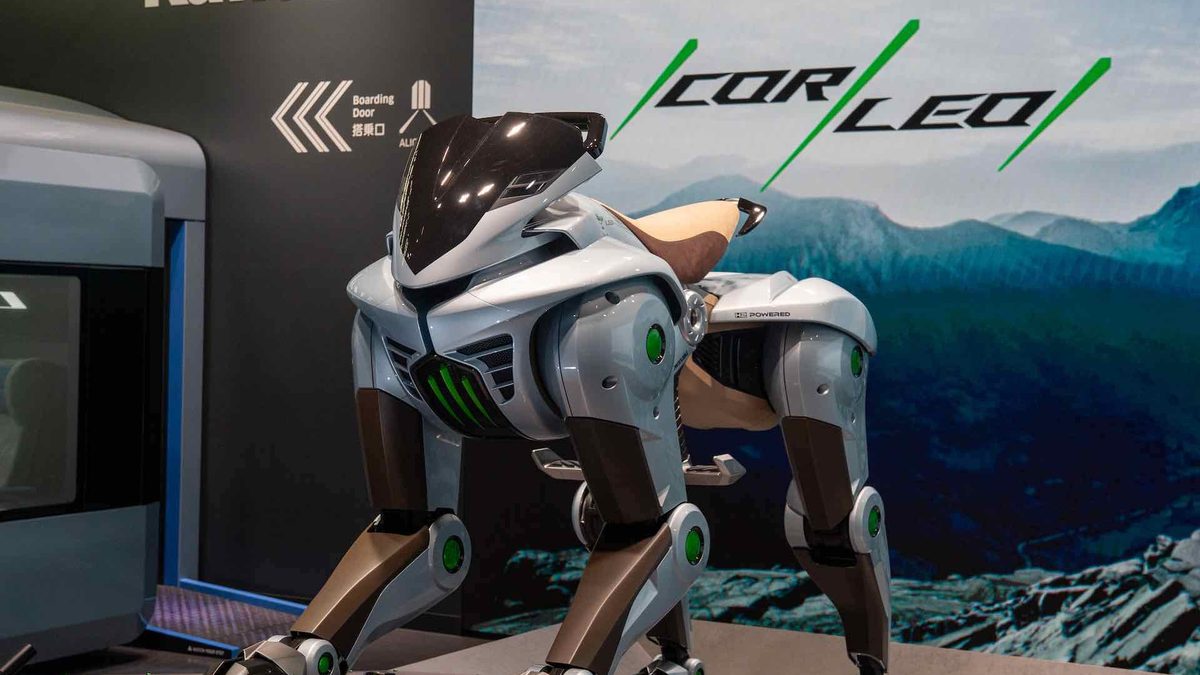
The last public day of EICMA 2026 at Fiera Milano Rho has a simple way of telling you which stand is working: look for the crowd that isn’t looking at a motorcycle. On Kawasaki’s booth (Hall 11, Stand N46), that crowd is standing around CORLEO, a full-scale mock-up of a four-legged, hydrogen-powered personal mobility vehicle that looks like someone crossed a sportbike with a very patient robot horse. Kawasaki Motors Europe put it on the stand so visitors could take in its physical size, and we’ve been circling back to it between the 2027 bikes. Unlike most show concepts, Kawasaki says CORLEO is being developed for full production and retail, with full commercialization targeted around 2035. For everything else we saw this week, see our 2026 EICMA Preview.
What’s New at EICMA 2026
- Full-scale mock-up of CORLEO, Kawasaki’s Robotic Multi-legged Vehicle (RMV), on Hall 11, Stand N46 for the public days of November 5–8
- Four-legged personal mobility concept that combines off-road robotics with motorcycle handling and stability
- Series-hybrid hydrogen power: Kawasaki Europe’s EICMA release lists a 150cc hydrogen engine that generates electricity; Kawasaki Heavy Industries’ current SAFE ADVENTURE vehicle page lists a 333cc turbocharged two-stroke hydrogen engine
- Hydrogen stored in removable storage-alloy canisters in the rear / rear-leg section
- Rider control through weight-shift inputs via stirrups and handholds, like riding a horse; stirrup length adjusts automatically
- Navigation system that detects weather, temperature, surface conditions and wildlife, shown on the instrument panel and on smart devices
- Project led by Kawasaki’s SAFE ADVENTURE Business Development Team, which reports directly to the president of Kawasaki Heavy Industries
- Full commercialization targeted around 2035; price, weight, dimensions and U.S. availability N/A
What CORLEO Actually Is
CORLEO is not a motorcycle, and it isn’t trying to be one. Kawasaki calls it a Robotic Multi-legged Vehicle, or RMV: a new type of personal mobility that uses four robotic legs to handle terrain wheels can’t, while borrowing the maneuverability and stability Kawasaki says it has spent more than half a century building into motorcycles. The stated goal on Kawasaki Heavy Industries’ EICMA note is “FUN TO RIDE,” the joy of riding itself.
Kawasaki first showed CORLEO as a concept at Expo 2025 in Osaka. The news this week is that the project has walked into the motorcycle world. Kawasaki Heavy Industries titled its October 29 note “RMV CORLEO Enters the World of Motorcycles,” and Kawasaki Motors Europe brought a full-scale mock-up to EICMA so people could stand next to it, walk around it and get a feel for its size. The machine on the stand is a mock-up, not a running production vehicle. Think of it as a show model that grew legs and learned how to gather a crowd.
How You Ride a Robot Horse
Kawasaki’s pitch is that you don’t ride CORLEO like a motorcycle. You ride it like a horse. The rider sits on a saddle and controls the machine through weight-shift inputs detected by the stirrups and handholds. Shift your center of gravity, and CORLEO reads that as intent. Kawasaki says the stirrups also change length automatically so the rider can keep an optimal posture, which is a nice trick if you’ve ever stood on the pegs of an adventure bike and wished the bike would meet you halfway.
The chassis has a movable shaft in the middle so the rear-leg mount can swing up and down independently of the front-leg mount. Kawasaki says that swingarm-style arrangement absorbs shock while walking and running, and it lets the rider keep a more natural view of the trail when climbing instead of staring at the sky. Each leg has a suspension designed for smooth bending and stretching, including what Kawasaki describes as dynamic actions such as agile jumps. At the bottom of each leg is a rubber hoof split left and right, like a cloven hoof. The rubber is meant to absorb surface irregularities and resist slipping on grassland, rock and loose gravel. Because the hooves take some of the impact, Kawasaki says the legs don’t have to spend as much energy on shock-absorbing control.
The robotics underneath that are faster than your reactions. Kawasaki says a torque controller and a controller with a cycle time of less than one millisecond keep the drive shafts in sync, which is how the legs stay flexible on contact. A system Kawasaki calls “adaptive shared control” changes how much the machine intervenes based on the rider’s skill. Commands that would send you off a cliff get corrected. A rider with higher skill is allowed a certain degree of risk. In other words, CORLEO is willing to let you be a hero, just not a cautionary tale.
The Hydrogen Engine, Twice
Here is where the spec sheet splits, and we’re not going to pretend it doesn’t. Kawasaki Motors Europe’s October 28 EICMA release says power comes from a 150cc hydrogen engine that generates electricity, with hydrogen stored in canisters at the rear of the vehicle. That same 150cc generator description appears on Kawasaki’s Expo 2025 CORLEO page, which says the electricity then drives units in each of the four legs.
Kawasaki Heavy Industries’ current SAFE ADVENTURE vehicle page, the official project site for CORLEO, describes a series-hybrid system that uses a 333cc turbocharged two-stroke hydrogen engine to generate electricity for actuators in the four legs and the body. That page also puts a radiator and an intercooler in the front of the chassis to control engine and intake-air temperatures, which Kawasaki says helps keep hydrogen combustion stable. We’re listing both displacements until Kawasaki publishes a single figure. This is a developing project with a commercialization target around 2035, so a changing engine spec is not shocking. Inventing a winner would be.
What both descriptions agree on is the basic idea: a hydrogen engine makes electricity, and electric actuators move the legs. That is a series hybrid, not a hydrogen fuel cell and not a battery-electric motorcycle with extra joints. Fuel is stored in hydrogen storage alloy canisters housed in the rear, or more specifically the rear-leg section on the SAFE ADVENTURE page. The canisters can be removed and swapped, so if you run out of hydrogen in the woods you can exchange them for fresh ones the way you’d swap a spare battery, provided you actually brought spares. Kawasaki has not published range, output, fuel capacity or a refill time, so those stay N/A.
Navigation and the SAFE ADVENTURE Pitch
CORLEO is the hardware piece of a larger Kawasaki Heavy Industries idea called SAFE ADVENTURE, which is about letting people enjoy mountains safely and in harmony with nature. Kawasaki says it will develop a CORLEO navigation system that detects weather, temperature, surface conditions and even the presence of wildlife, then guides users onto safer routes. The service is supposed to appear on CORLEO’s instrument panel and on smart devices. The earlier Expo 2025 materials get more specific about the dash: hydrogen level, the route to the summit, the rider’s center of gravity, and at night, markers projected onto the path ahead. Whether a production machine around 2035 still does all of that is another question.
The project sits under Kawasaki’s Group Vision 2030, in three focus fields: a safe and secure remotely connected society, near-future mobility, and energy and environmental solutions. The SAFE ADVENTURE Business Development Team reports directly to the president of Kawasaki Heavy Industries, which is Kawasaki’s way of saying this is not a side sketch that escaped from the design studio. Shigemi Tanaka, Managing Director of Kawasaki Motors Europe, put it like this: “Kawasaki is at the forefront of many fields of endeavour and research. CORLEO is one example not only of our unique company-wide depth of technical, industrial and environmental experience, but also of our drive towards a carbon-neutral future – one that embraces personal freedom through the SAFE ADVENTURE concept.”
Design: Part Animal, Part Ninja
Kawasaki says CORLEO is meant to look approachable and dynamic, inspired by animals, while still being a feasible mobility vehicle. It also leans on the company’s usual motorcycle words: powerful and sporty. The mock-up on the stand wears a silver body with brown accents, a tan saddle, a dark windscreen and green joint covers, plus an “H2 POWERED” graphic on the flank that refers to hydrogen, not the supercharged Ninja H2. Ergonomics were checked with a clay mock-up and the help of Kobe University’s equestrian club, which verified stability in the saddle and made sure the proportions wouldn’t get in the rider’s way. When you need riding-position advice for a robot horse, you call the people who already ride horses.
Kawasaki CORLEO Specs
| Spec | Kawasaki CORLEO |
|---|---|
| Status | Full-scale mock-up of a concept developed for intended production and retail |
| U.S. MSRP | N/A (not announced) |
| Europe price | N/A (not announced) |
| Target commercialization | Around 2035 (Kawasaki Motors Europe); EICMA lists 2035 |
| Type | Robotic Multi-legged Vehicle (RMV); four-legged personal mobility |
| Power unit | Series hybrid. Kawasaki Europe EICMA release and Expo 2025 page: 150cc hydrogen engine generating electricity. KHI SAFE ADVENTURE vehicle page: 333cc turbocharged two-stroke hydrogen engine generating electricity for leg and body actuators |
| Cooling | Radiator and intercooler in the front of the chassis (SAFE ADVENTURE) |
| Fuel | Hydrogen storage alloy canisters in the rear / rear-leg section; removable and swappable |
| Claimed output / range / fuel capacity | N/A (not published) |
| Controls | Rider weight-shift via stirrups and handholds; automatic stirrup-length adjustment |
| Chassis | Mid-chassis movable shaft; rear-leg mount swings vertically relative to the front-leg mount |
| Legs / suspension | Four robotic legs with suspension for bending, stretching and jumps; torque control and a controller cycle of less than one millisecond; adaptive shared control |
| Contact patches | Rubber left-and-right split cloven hooves |
| Display / navigation | Instrument panel plus smart devices; weather, temperature, surface conditions and wildlife. Expo 2025 materials also list hydrogen level, summit route, center of gravity and night path projection |
| Dimensions / weight / seat height | N/A (mock-up shown so visitors can judge physical size) |
| U.S. availability | N/A (not announced) |
| Shown | EICMA 2026, Hall 11, Stand N46, public days November 5–8 |
Price and Availability
There is no price. Kawasaki has not published a U.S. MSRP, a European price or a reservation program, and the company has not said when, or whether, CORLEO will be sold in the United States. The only timing Kawasaki will put on paper is the commercialization target: around 2035, according to Kawasaki Motors Europe. EICMA’s own write-up says full commercialization in 2035. That’s about nine years from this show, which is a long time to wait for a test ride. Until Kawasaki publishes real numbers, treat every rumor about cost, range or performance as unverified.
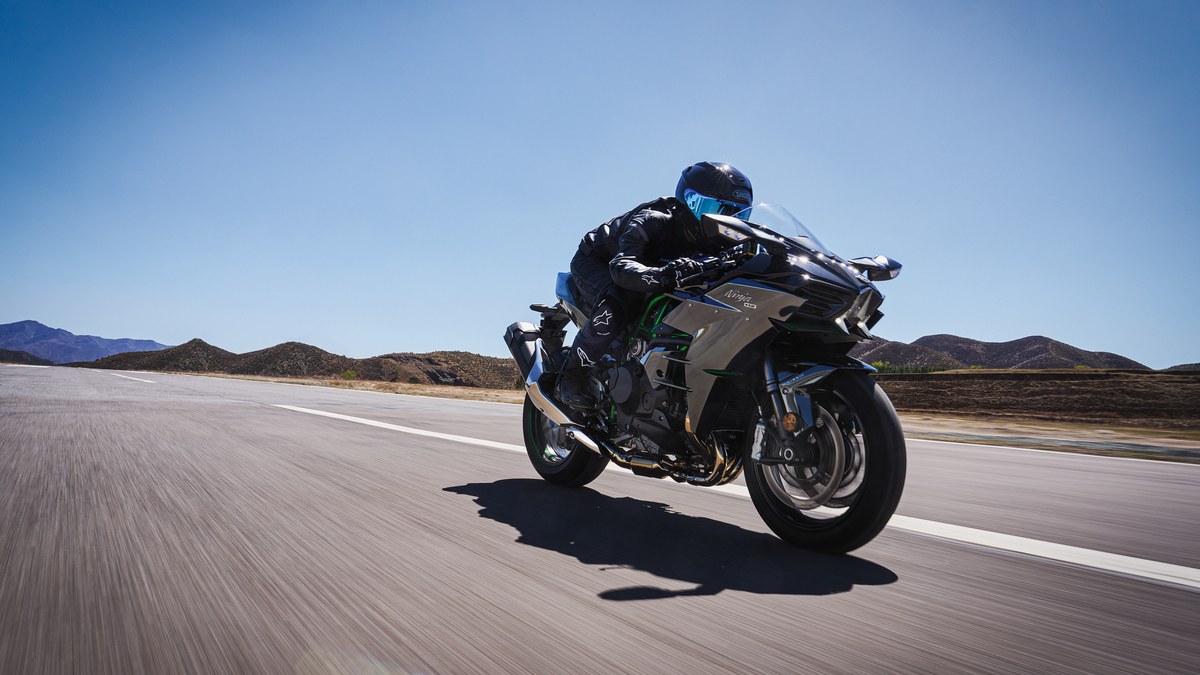
What you can do right now is look at it. Kawasaki staff from Japan have been on the Hall 11 stand to explain the project during the public days, and the mock-up is there so visitors can judge its size in person. While you’re in that aisle, the same booth has been showing Kawasaki’s new 2027 motorcycles, including the Versys 900, KLE650, KLE500 SE Smartride, Ninja 650 and KX327.
Our Take From Milan
We’ll be honest: we came to EICMA for motorcycles, and we kept walking back to the robot horse. CORLEO is the rare concept that doesn’t feel like a styling exercise. Kawasaki is talking about production, a hydrogen series hybrid, real off-road robotics and a navigation system aimed at keeping people out of trouble in the mountains. The mock-up on the stand makes the scale real in a way a rendering never will. The caveats are just as real. The engine displacement does not match across official pages, there is no price, no weight and no timeline tighter than “around 2035,” and the machine in Hall 11 is a mock-up. If Kawasaki can turn this into something you can actually swing a leg over in the next decade, it will be one of the stranger and more interesting things to come out of the motorcycle industry. Until then, it’s the best crowd-stopper in the building, and a reminder that the companies building our bikes are also thinking about what comes after wheels. For more Kawasaki news, see our Kawasaki motorcycles section. For the rest of the show, keep an eye on our EICMA Motorcycle Show hub.
FAQ
What is the Kawasaki CORLEO?
CORLEO is Kawasaki’s Robotic Multi-legged Vehicle, a four-legged personal mobility concept that combines off-road robotics with motorcycle-inspired handling and stability. Kawasaki showed a full-scale mock-up on its EICMA 2026 stand in Hall 11.
How is CORLEO powered?
It uses a series-hybrid hydrogen engine to generate electricity for actuators in the legs. Kawasaki Europe’s EICMA release lists a 150cc hydrogen engine; Kawasaki Heavy Industries’ SAFE ADVENTURE page lists a 333cc turbocharged two-stroke hydrogen engine. Hydrogen is stored in swappable canisters at the rear.
When can you buy a CORLEO?
Kawasaki Motors Europe targets full commercialization around 2035. No on-sale date, market list or reservation program has been announced.
How do you control it?
By shifting your weight, much like riding a horse. Stirrups and handholds detect those inputs, and the stirrups adjust length automatically to help the rider keep an optimal posture.
How much does the Kawasaki CORLEO cost, and how much does it weigh?
Price, weight and dimensions are N/A. Kawasaki has not published those figures.