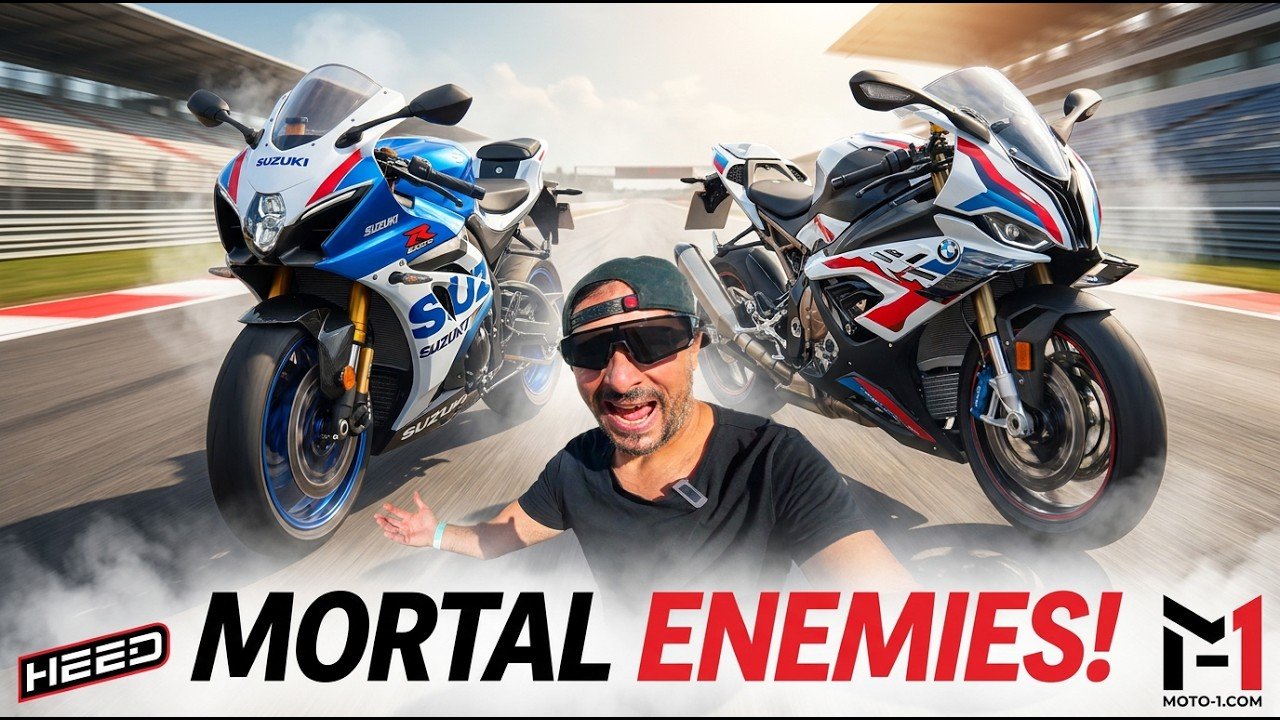
Hamamatsu muscle meets Bavarian tech at Chuckwalla
Summary: The BMW S1000RR wins our Chuckwalla track comparison against Suzuki’s GSX-R1000R. Our $28,065 M Package BMW brings semi-active DDC suspension, deeply adjustable electronics and sharper brakes. The $17,939 Suzuki counters with a sweet-sounding inline-four, easy manners and a bargain price, but its rider aids are tied to riding modes and its fork feels softer.
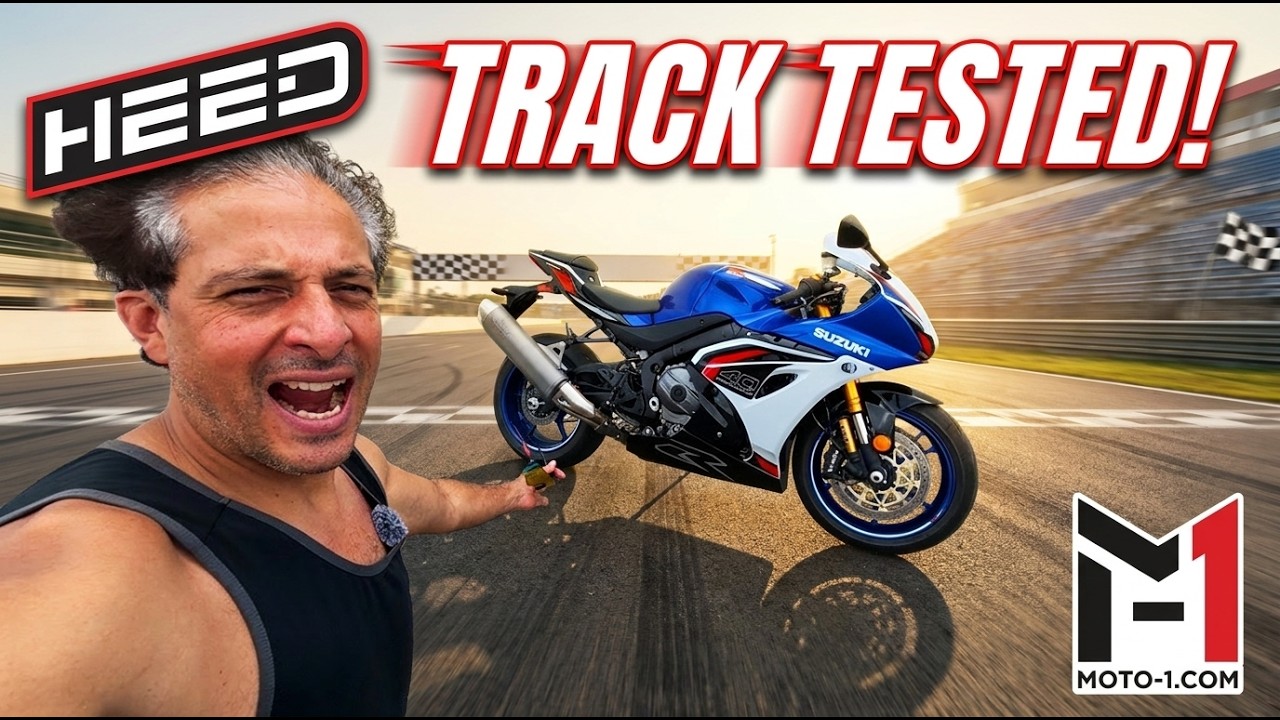
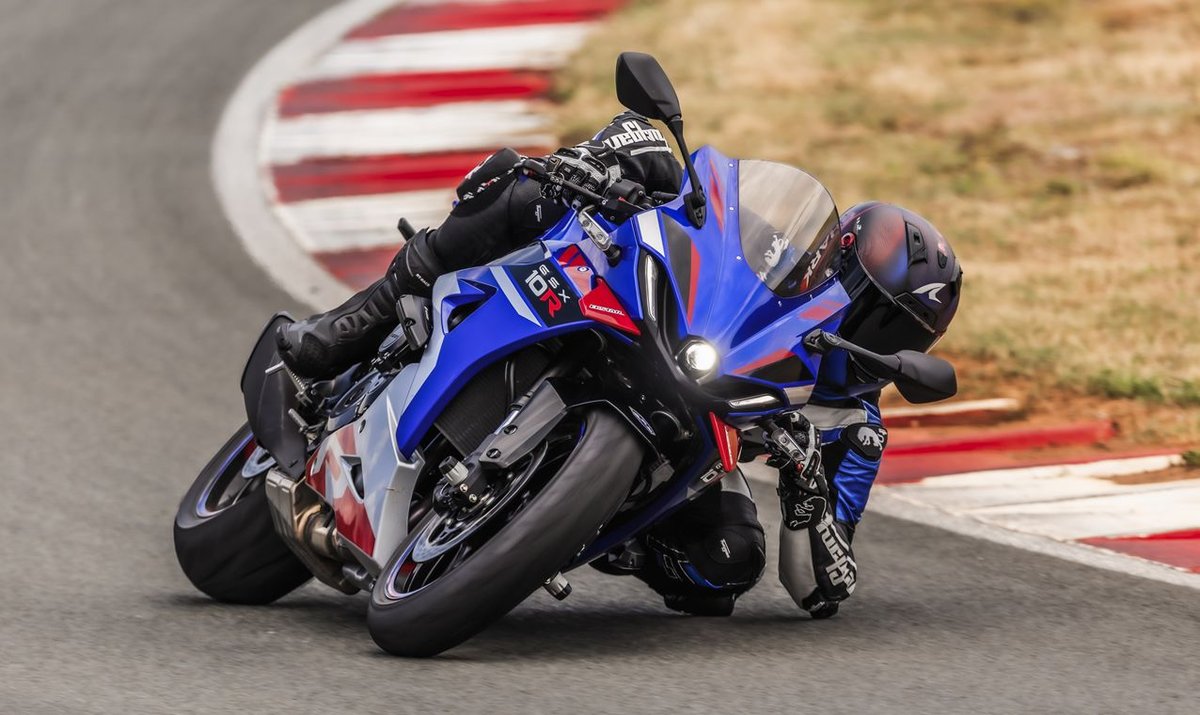
This one’s a clash of the heavyweights. In this Suzuki GSX-R1000R vs. BMW S1000RR track comparison, we take Hamamatsu’s freshly updated Gixxer and Bavaria’s M Package Double R to Chuckwalla Valley Raceway in the Southern California desert and ride them back to back. The question is simple: is the BMW worth $10,000 more than the Suzuki? The S1000RR arrived in America for the 2010 model year with the GSX-R1000 squarely in its crosshairs, then stole everyone’s thunder and became the top superbike in America for years. Time for a rematch.
The $10,000 Question
Suzuki’s 2027 GSX-R1000R 40th Anniversary Edition retails for $17,939. Our BMW S1000RR is dripping in M Motorsport paint and carbon fiber, with the M Package carbon wheels, the BMW accessory rearsets and the billet clutch and brake levers we covered in our road test. Configured like that, it retails for about $28,065. That’s $10,000 more than the Gixxer. A base 2026 S1000RR starts at $19,895, so most of that gap is options, not the bike itself.
We’ve covered the updated GSX-R1000R in our Garage Talk, out on the road, in Real MC Commute and at the track, so check those stories for all the tech details. The S1000RR has been with us plenty, too.
BMW S1000RR: Mild to Wild With a Few Button Pushes
The BMW gives you a ton of adjustment. You can tune engine power, throttle response, engine brake, traction control, wheelie control and ABS. For our first session I set up Race Pro 1: a slightly more moderate throttle response, max engine brake, the least amount of traction and wheelie control, and a decent amount of damping. Our bike is also set up with reverse, GP-style shifting: one up, five down.
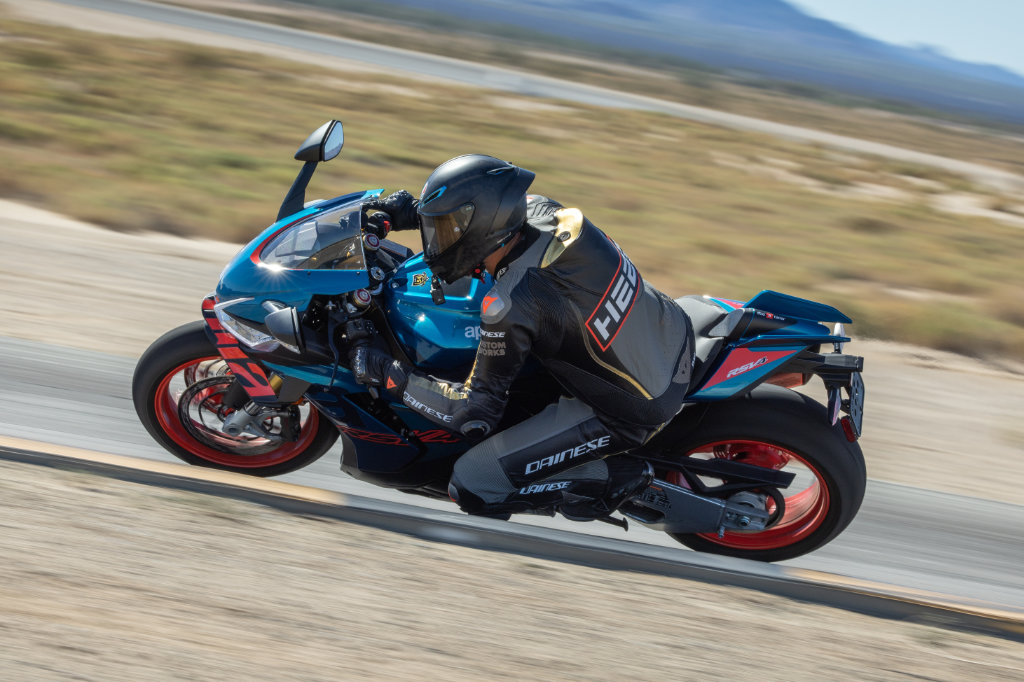
Right away, this thing eats. The ergonomics are spot on for the track: a tall seat and low clip-ons put you in a very sporty, track-oriented riding position. It feels like a superbike should, tall in the rear and low in the front, and this 437-pound liter bike is apt to change direction. The engine does buzz, with quite a lot of vibration on the racetrack, same as we noticed on the street.
Roll through the gearbox and the inline-four just gets with the program. It pulls hard. The final-drive gearing is on the low side, which complements the power band and keeps the bike driving forward. Our S1000RR runs the torque map, so we have maximum torque, but in U.S. trim it’s horsepower-restricted from the factory. Funny thing: for all the changes BMW has made, a showroom-stock S1000RR is slower than the original was off the dealer floor, because it’s locked out from the factory. You can always reflash it and unlock the extra ponies.
The chassis balance is excellent. The fork gently compresses into the pavement and transfers load into the ground without pitching like crazy, and it has very little stiction. We let the DDC semi-active suspension do the heavy lifting; it automatically adjusts damping based on rider inputs and vehicle data. Those M carbon wheels make a huge difference, too. This bike changes direction like a much lighter machine.
Chuckwalla is a tighter, slower track that isn’t really designed for high-horsepower liter bikes, so it’s hard to stretch the S1000RR’s legs and give you a full read on what its Dynamic Traction Control is doing. So far, so good. The quickshifter allows full-throttle upshifts and downshifts without the clutch, which is especially nice on corner entry. The brakes are sharp, with good power and feel, and that planted front end lets you use them with authority. All that braking G-force goes into the Pirelli tires and right into changing direction.
The power band is so flexible that you can just run third gear and let her eat. The slipper clutch works well, the wind bubble is nice and tall, and the BMW accessory rearsets let you tweak your riding position while their footpegs grip your boot soles. Want more or less traction control? Tap the DTC button on the fly, from plus six to minus six. I even felt a little tire slip, which is the whole point of DTC. It allows the good kind of wheelspin, the kind that keeps your momentum up.
Suzuki GSX-R1000R: Old-School Feel, Modern Twist
Now for the Hamamatsu heavy hitter. It doesn’t have wings or crazy bodywork, but the Gixxer looks slippery and awesome in its 40th Anniversary livery. It has a keyed ignition, which we like. Compared to the BMW, the electronics are a lot simpler. You pick a combined engine power and throttle mode, A, B or C (A is the most aggressive), and traction control 1 through 10, with 1 being the least. That’s it. The GSX-R has cornering ABS and wheelie control, but they’re tied to the riding mode. You can’t fine-tune them individually, and you can’t adjust engine brake. Good thing or bad thing? Let’s find out.
That inline-four sounds oh so tasty. The LCD screen isn’t the best we’ve seen, but what do you expect for $10,000 less? This GSX-R is taller and more aggressive than past Gixxers, but it still feels rooted in the old world of sportbikes. The handlebar is narrow and angled inward. The seat isn’t that tall. You don’t sit in it low like an old-school GSX-R600 or 750, but it doesn’t feel as racy as the BMW either.
The Suzuki has significantly less engine braking than the BMW. To be fair, we ran the BMW at max engine brake, which helps slow the bike down entering corners. When I’m really on it, I like no engine brake, but when I’m warming up or haven’t been on track in a while, max engine brake keeps entry speeds in check, so you don’t need the front brake nearly as much.
Then you crack the throttle. Listen to that Hamamatsu muscle! This bike sounds the business. It uses a conventional firing order, not the uneven crossplane beat of Yamaha’s YZF-R1, and the power pulses feel great. The Suzuki’s final-drive gearing is a little taller than the BMW’s. It has good midrange, so you can leave it in third, but second works too. The BMW comes off corners a little harder thanks to its shorter gearing and torque map, but the GSX-R pulls hard up top. The BMW is a touch more agile side to side, but the Suzuki is close, and it feels great at lean.
Historically, I haven’t loved GSX-R1000 front brakes, but the Brembos on this bike are doing a good job, without a lot of fade. They’re not quite as sharp as the BMW’s, though. The fork works, but it doesn’t have the same hold-up. It collapses more and feels squishy, not in a good way. On the other hand, I love how connected the rear suspension feels and how connected I am to the throttle. The throttle response can be surgy, and the electronics package is the GSX-R’s weak link: it just doesn’t have the arsenal to let you command the bike like the BMW. Still, if you want an organic, pushable superbike, it delivers. It’s a hoot, it’s easy to ride, and it has that old-school Japanese feel with a modern twist. And the price is an absolute steal.
Sponsored by Speed Addicts
This episode is supported by SpeedAddicts.com, the fastest-growing gear site around. You get a huge selection of new parts, gear and accessories, in-depth product breakdowns, no-cost exchanges and killer deals on the best brands. Orders over $50 ship free. If you’d rather shop in person, swing by the Speed Addicts Superstore in Orange, California, open seven days a week.
Verdict: BMW S1000RR Wins
It was a hoot lining these two up on the grid again, but there’s a clear winner. The Suzuki is crazy easy to ride, and once that engine spools up it pulls hard and sounds even harder. But its old-school superbike ergonomics don’t feel as modern as the BMW’s, and its suspension, while good, can’t match the BMW’s semi-active damping control.
Yes, the BMW costs $10,000 more as tested, but it goes from mild to wild with a few swipes of a button. Its engine is electronically restricted from the factory, yet with the torque map, the shorter final drive and tight gear ratios, it hops off corners like a maniac. Even locked, it makes a crazy amount of power, probably equal to or a little more than the GSX-R1000R.
If you want a really affordable, capable superbike for the track and you’d rather spend the savings on a pallet of tires, the GSX-R1000R is your bike. If you want a bike that’s equally good on the racetrack and the street, with modern superbike electronics and a chassis you can reshape with the push of a button, the S1000RR is hard to beat. It wails on the track, it wails on the street, and it looks sick as hell. BMW’s S1000RR is our winner. Tell us in the YouTube comments which bikes we should test next.
Want more? Read our 2027 Suzuki GSX-R1000R Track Review, the 2027 Suzuki GSX-R1000R Garage Talk and our 2025 BMW S1000RR Real MC Commute, which features this same M Package bike on the street.
Suzuki GSX-R1000R vs. BMW S1000RR Specifications
| Spec | 2027 Suzuki GSX-R1000R 40th Anniversary Edition | 2025 BMW S1000RR M Package |
|---|---|---|
| U.S. MSRP | $17,939 plus $750 destination | $28,065 as tested with M Package and options |
| Warranty | 12-month unlimited-mileage limited warranty | 3 years / 36,000 miles |
| Engine | 999.8cc liquid-cooled DOHC inline-four; Suzuki Racing Variable Valve Timing (SR-VVT) | 999cc inline-four; BMW ShiftCam variable valve timing |
| Bore x stroke | 76.0mm x 55.1mm | 80.0mm x 49.7mm |
| Compression ratio | 13.8:1 | 13.3:1 |
| Claimed output | Not published | 205 hp @ 13,000 rpm; 83 lb-ft @ 11,000 rpm |
| Fuel system | Fuel injection with ride-by-wire throttle bodies | Electronic fuel injection; M Quick Action Throttle |
| Transmission / clutch | Six-speed cassette-style; bi-directional quickshifter; SCAS slipper-assist clutch | Six-speed; up/down quickshifter; self-reinforcing slipper clutch |
| Final drive | DID 525HV3 chain | 525 chain, 17/46 |
| Frame | Twin-spar aluminum; adjustable swingarm pivot | Cast-aluminum bridge frame; M Chassis Kit |
| Front suspension | Showa Balance Free Front (BFF) inverted fork | 45mm inverted fork, fully adjustable; 4.7 in travel; DDC semi-active damping on our bike |
| Rear suspension | Link-type Showa Balance Free Rear Cushion Lite (BFRC-lite) shock | Full Floater Pro, fully adjustable; 4.6 in travel; DDC semi-active damping on our bike |
| Front brakes | Twin discs, Brembo Monobloc four-piston calipers | Twin 320mm discs, four-piston fixed calipers |
| Rear brake | Single disc, Nissin one-piston caliper | 220mm disc, one-piston floating caliper |
| ABS | Lean-sensitive Motion Track ABS | ABS Pro with Race ABS |
| Rider aids | Bosch IMU; traction control; Roll Torque Control; Lift Limiter; launch control | Riding Modes Pro (Race Pro 1-3); Dynamic Traction Control; wheelie control; engine-brake control |
| Tires | Bridgestone Battlax Racing Street RS11; 120/70ZR17 front, 190/55ZR17 rear | 120/70 ZR17 front; 190/55 ZR17 rear (200/55 ZR17 with M wheels) |
| Wheelbase | 55.9 in | 57.3 in |
| Seat height | 32.5 in | 32.7 in (M Sport seat: 33.7 in) |
| Fuel capacity | 4.2 gal | 4.3 gal |
| Weight | 448 lb curb | 437 lb road-ready |
| Instruments | LCD multifunction panel | 6.5-inch TFT |
Suzuki GSX-R1000R vs. BMW S1000RR FAQ
Which is better on the track, the Suzuki GSX-R1000R or the BMW S1000RR?
The BMW S1000RR. Its semi-active DDC suspension, adjustable electronics, sharper brakes and agile M carbon-wheeled chassis make it the better track bike. The GSX-R1000R is easier on the wallet, sounds fantastic and is easy to ride fast.
How much do the GSX-R1000R and S1000RR cost?
The 2027 GSX-R1000R 40th Anniversary Edition is $17,939 plus $750 destination. A base 2026 S1000RR is $19,895 plus $695 destination, and our M Package test bike retails for about $28,065.
Which is lighter?
The BMW, at 437 pounds road-ready versus 448 pounds curb weight for the Suzuki.
What tires did the Suzuki run?
The GSX-R1000R wears its stock Bridgestone Battlax Racing Street RS11s. The BMW ran Pirelli rubber.
Can you adjust the GSX-R1000R’s electronics individually?
Not really. You choose an A, B or C power mode and traction control levels 1 through 10. Wheelie control and cornering ABS are tied to the riding mode, and engine brake isn’t adjustable.
More Superbike Coverage on Moto-1
- 2027 Suzuki GSX-R1000R Real MC Commute
- 2027 Suzuki GSX-R1000R History Review
- 2027 Suzuki GSX-R1000R vs. 2026 Aprilia RSV4
- 2026 BMW S1000RR Review
- 2026 Aprilia RSV4 Factory vs. BMW S1000RR
- 2026 Honda CBR1000RR-R Fireblade SP vs. Yamaha YZF-R1M
- 2027 Suzuki GSX-10R Preview
- Sportbikes
- Motorcycle Shootouts and Bike Comparisons
- Suzuki Motorcycles
- BMW Motorcycles