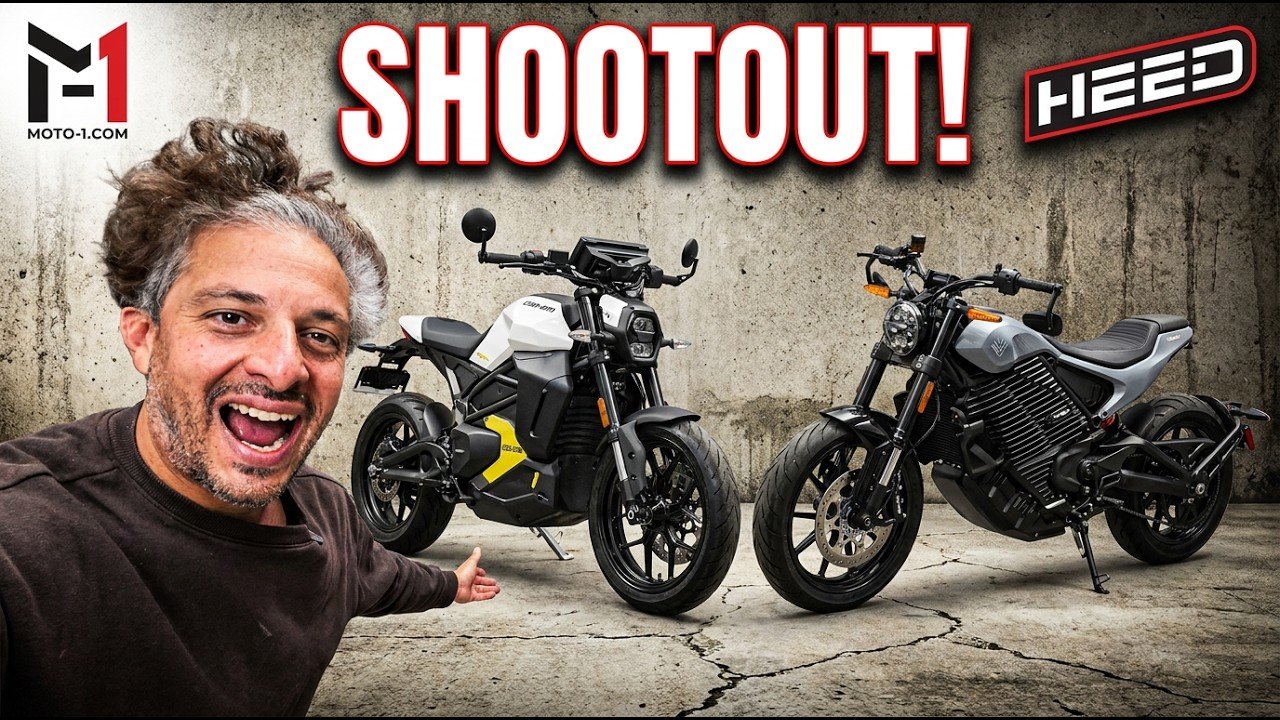
Torque vs. Touchscreen
Nearly 4x the torque, or $5,000 back in your pocket?
Summary: The 2026 LiveWire S2 Alpinista is the faster, better-built electric street bike, with 194 lb-ft of torque, a 99-mph top speed and Brembo brakes for $12,999. The 2025 Can-Am Pulse is 44 pounds lighter, adds a 10.25-inch touchscreen and backlit switchgear, and with Can-Am’s $6,000 rebate it costs about $5,000 less.
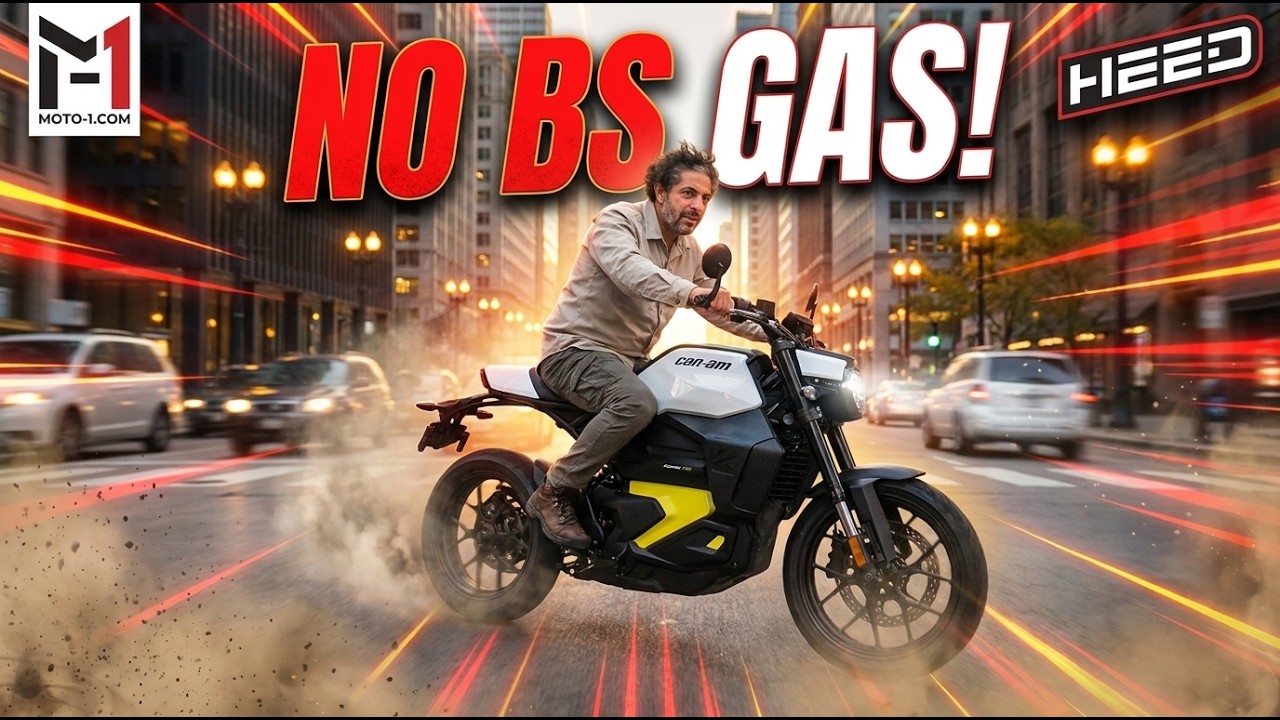
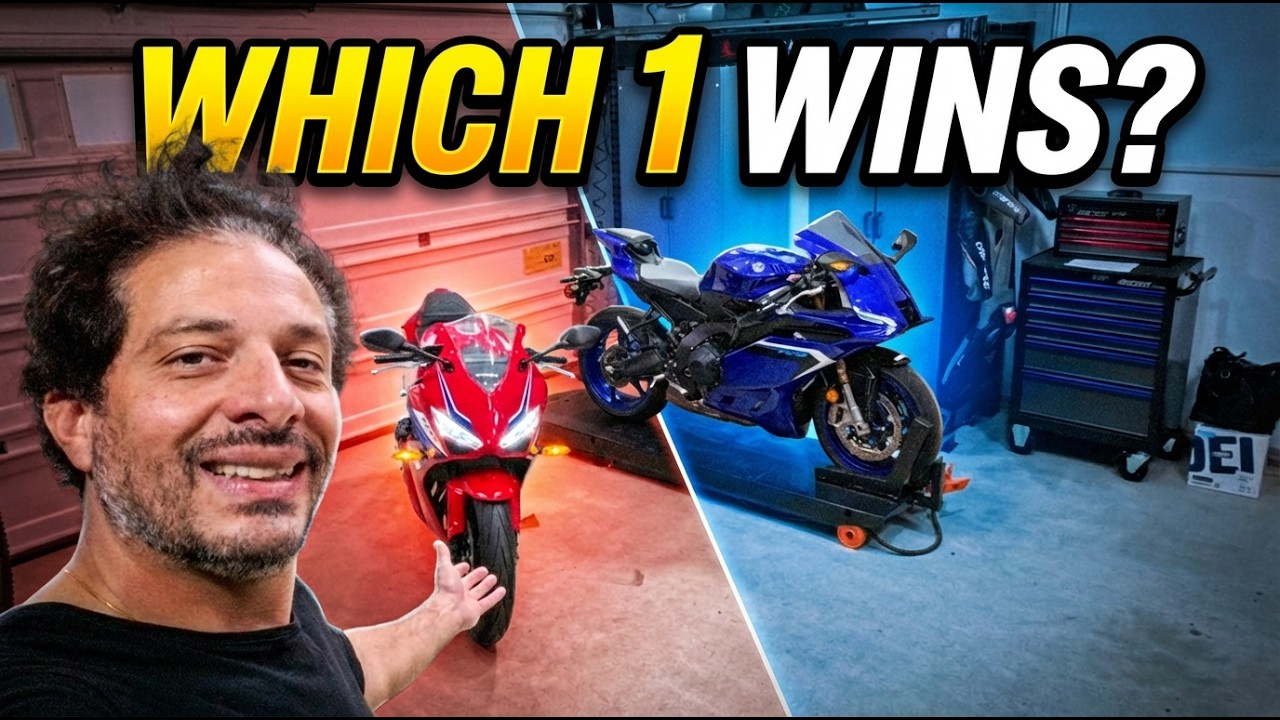
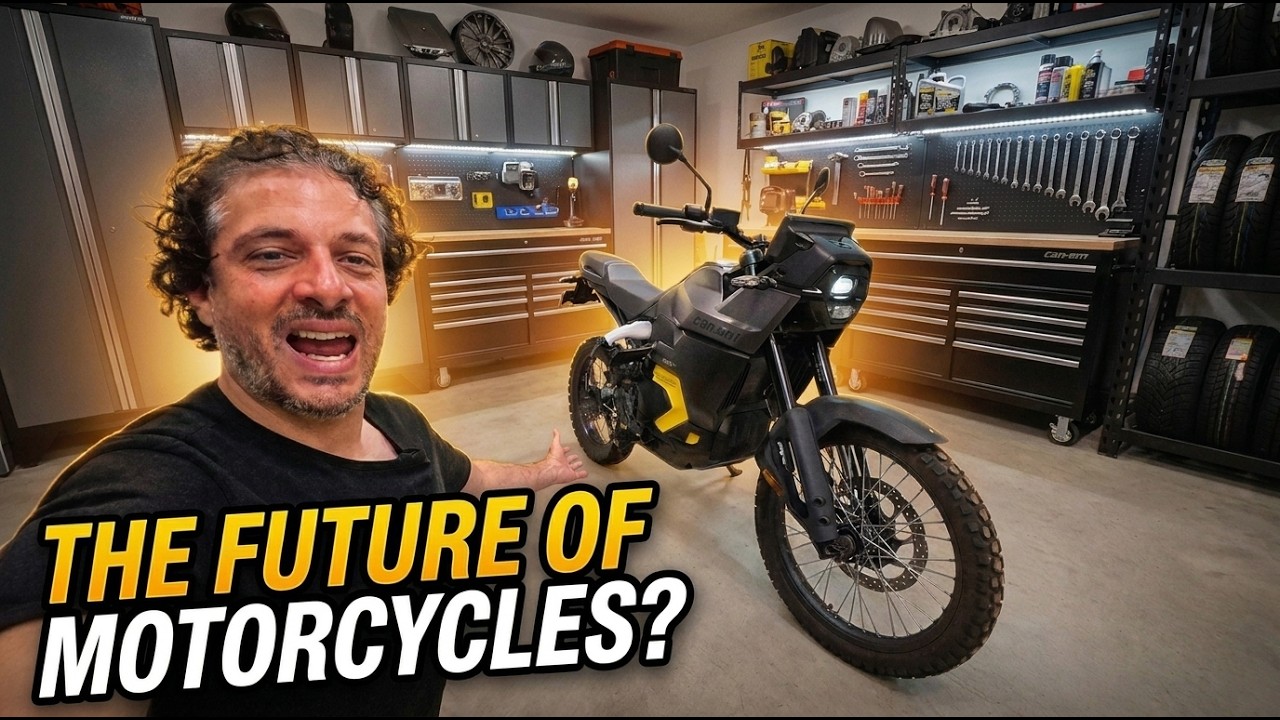
Good morning, party people. This episode of Garage Talk puts two fully street-legal electric motorcycles side by side: Can-Am’s 2025 Pulse and Harley-Davidson’s 2026 LiveWire S2 Alpinista. Both are built for urban riders who want to get outside, have some fun and, most importantly, not burn any gas. We walk around both bikes in the garage first. The head-to-head street ride comes in the next episode, so think of this as the weigh-in before the fight.
If you missed the solo walkarounds, catch up with our 2026 Harley-Davidson LiveWire S2 Alpinista Garage Talk Review and the 2025 Can-Am Pulse Garage Talk Review.
Sponsored by Speed Addicts
This episode is supported by SpeedAddicts.com, the fastest-growing gear site around. You get a huge selection of new parts, gear and accessories, in-depth product breakdowns, no-cost exchanges and killer deals on the best brands. Orders over $50 ship free. If you’d rather shop in person, swing by the Speed Addicts Superstore in Orange, California, open seven days a week.
Power and Battery: Not a Fair Fight
We’ll start with the LiveWire, since it got here first. Harley-Davidson’s original LiveWire showed up for the 2020 model year, and the bike has changed quite a bit since, though the essentials haven’t. The S2 Alpinista carries a 10.5 kWh lithium-ion battery against the Pulse’s 8.9 kWh pack, so the LiveWire gets a little more capacity.
The motor gap is much bigger. LiveWire rates the Alpinista at 194 lb-ft of torque (84 hp). Can-Am rates the Pulse’s Rotax E-Power motor at 53 lb-ft (47 hp peak, 27 hp continuous). That’s nearly four times the torque, and you’re going to feel it when we hit the road. Top speed follows the same script: 99 mph for the LiveWire, 80 mph for the Pulse. You don’t really want to ride either one at top speed anyway, because the battery drains fast at those speeds.
Look at the LiveWire’s battery case. I love that machined finish on the side; it looks super cool. The Pulse’s pack has some nice futuristic lines, but it’s a lot more plasticky and utilitarian. So the LiveWire has the much more powerful motor, a slightly bigger battery, and the better-looking hardware too.
Charging and Range
Both bikes can be charged at home with a Level 1 or Level 2 J1772 charger (we have one in the corner of the garage). On Level 2, Can-Am quotes 20 to 80 percent in 50 minutes. LiveWire quotes 78 minutes for the same 20 to 80 percent. Fun fact: the LiveWire’s charge port is on the left side and the Can-Am’s is on the right.
The LiveWire’s larger battery should mean more range. On paper, LiveWire claims 120 miles city, 89 miles combined and 71 miles at a sustained 55 mph. Can-Am claims 100 miles city, 80 miles combined and 55 miles at a sustained 50 mph. Keep in mind the two brands use different test procedures (SAE J2982 for LiveWire, WMTC for Can-Am’s combined figure), so don’t compare those numbers like apples to apples. We’ll see how they do in real-world riding in the street test.
Weight, Size and Chassis
The Pulse weighs 390 pounds. LiveWire lists the Alpinista at 434 pounds, so it’s about 45 pounds heavier, and you feel that when you lift it off the sidestand. Once it’s rolling on 17-inch wheels, though, the weight disappears. The Pulse also feels smaller. Its seat is a little lower, and when you’re sitting on both bikes, the Can-Am feels about nine-tenths the size of the Harley. If you’re a smaller rider, you’ll probably fit the Pulse a bit better. That’s not to say the LiveWire isn’t small-rider friendly.
Both bikes use inverted forks. The Pulse has a 41mm KYB fork with fixed damping and 5.5 inches of travel. The LiveWire runs a fully adjustable 43mm Showa fork with 4.72 inches of travel, and you can adjust compression and rebound right at the top of the fork legs. Out back, the LiveWire’s Showa shock attaches between the top of the battery housing and a linkage. The Pulse’s shock runs from the top of the battery housing straight to the bottom of the motor. There’s no linkage, just a direct design. The Pulse’s motor also looks smaller, though to be fair, the Harley’s motor is partly hidden under plastic.
Fit and Finish: Hand It to Harley
We really have to hand it to Harley-Davidson here. The LiveWire is a much more well-put-together motorcycle: better paint, better materials and a lot more metal. Yes, there’s still plastic on the switchgear and a few other places, but overall build quality is a step above the Pulse. The Can-Am is far more plasticky, and its fasteners don’t look nearly as high quality.
Brakes tell the same story. The Pulse uses J.Juan brakes (J.Juan is a Spanish Brembo subsidiary), while the LiveWire wears genuine Brembo hardware, including an M4.32 Monobloc caliper up front. You can see the name right on the master cylinder cap.
The LiveWire also rides on bigger rubber: a 120/70 front versus the Pulse’s 110/70 front, with a 180/55 rear versus the Pulse’s 150/60. You still get real motorcycle tires on the Pulse, just not big-bike sizes, which makes sense given how much smaller it feels.
Where the Pulse Fights Back
We do like the Pulse’s single-sided swingarm, which shows off that 17-inch rear wheel. The Harley doesn’t have one, but its oversized boomerang-shaped swingarm is really cool, and the Pulse’s arm looks a little puny next to it. The Pulse also has a sealed final drive (Can-Am calls it a chaincase with a silent chain, oil-lubricated and auto-tensioned), so there’s virtually no maintenance. The LiveWire uses a more conventional belt final drive. Its footpegs are nice and chunky, too.
Power them up and the Pulse lights a big, oversized 10.25-inch color touchscreen with Apple CarPlay, and its switchgear is backlit, which is a really nice touch. The LiveWire has a much smaller 4-inch round color TFT that isn’t a touchscreen. Realistically, though, I like the LiveWire’s display. It fits the vibe of a motorcycle really well. The Can-Am’s screen is cool for you technophiles out there, but it just looks a little too big.
Both bikes have switchgear buttons for your Bluetooth headset, which is kind of odd, because you can just use voice commands on most headsets. That’s a lot of wasted real estate on both bikes. Backlit switches are sadly missing from the Harley. On the LiveWire, you change power modes with the mode button. On the Pulse, I believe you go through the menu system. Can-Am lists Normal, ECO, Rain and Sport+ modes, so it’s two different ways of doing the same thing.
The Pulse is also noisier. Turn the key and you hear the electronics whirring, even when it’s sitting still. The Harley is nice and quiet. The only time you really hear it is when the fans cool the inverter after a ride, and when it’s charging.
Storage, USB and Lighting
The Pulse has a little glove box with a plasticky latch, big enough for your phone and some other small stuff, plus a USB charging port. It’s a conventional USB-A port. The LiveWire doesn’t really have any storage up front, which is a shame, but it does have a USB-C port, which is really cool. The test bike also wore the OE SW-Motech accessory side bags, about $1,500, which are oh so tasty and add a lot of function.
Both bikes have bold, beautiful LED headlights, and both use curved radiators to help shed heat from the powertrain. Oddly, the Can-Am’s radiator is quite a bit taller than the Harley’s, even though the Harley is way more powerful. You’d think the LiveWire would get the bigger radiator, but it doesn’t.
Warranty and Where They’re Built
Both bikes carry a two-year vehicle warranty and a five-year battery warranty. Can-Am caps its battery coverage at 31,068 miles. LiveWire’s battery warranty is unlimited mileage, and its spec sheet notes a 30 percent degradation threshold. The Pulse is built at BRP’s plant in Querétaro, Mexico. LiveWire says all its motorcycles are assembled in York, Pennsylvania, at the same Harley-Davidson plant that builds Harley’s own motorcycles. So you’re looking at an American-made bike versus a Mexican-made bike.
Price: The Pulse’s Trump Card
Here’s where it gets interesting. The 2025 Can-Am Pulse originally listed at $13,999 (call it $14,000), but Can-Am’s factory sale, still advertised on its 2025 Pulse page as of October 2026, takes up to $6,000 off select 2025 models and adds a $1,500 accessory credit. That brings this bike to about $8,000, plus $1,500 toward accessories. The LiveWire S2 Alpinista lists at $12,999 with no sales or rebates right now. Before the rebate, the LiveWire was actually about $1,000 cheaper. With the rebate, the Pulse is about $5,000 less than the LiveWire, and you get the accessory credit too. Rebates come and go by region, so check with your dealer before you go shopping. For reference, Can-Am lists the 2026 Pulse at $10,999.
Garage Verdict (For Now)
The LiveWire is faster, has more carrying capacity, has a little higher-quality suspension and weighs a little more, but you’re getting a much higher-quality motorcycle. The Can-Am counters with that big touchscreen, backlit switchgear, a cool single-sided swingarm and a price that’s about $5,000 lower while the rebate lasts.
Now it’s time to swing a leg over these things out on the road and tell you which one’s best. Who’s ready to ride? Until that episode drops, dig into our 2025 Can-Am Pulse Urban Road Test, our 2026 Can-Am Origin Electric Dual-Sport Review and our guide to street-legal electric motorcycles.
2025 Can-Am Pulse vs. 2026 LiveWire S2 Alpinista Specifications
| Spec | 2025 Can-Am Pulse | 2026 LiveWire S2 Alpinista |
|---|---|---|
| U.S. MSRP | $13,999 (2025 MSRP); up to $6,000 factory rebate + $1,500 accessory credit advertised on select 2025 models (2026 Pulse: $10,999) | $12,999 |
| Warranty | 2 years vehicle; battery 5 years / 31,068 miles | 2 years vehicle, unlimited mileage; battery 5 years, unlimited mileage (30% degradation) |
| Motor | Rotax E-Power, liquid-cooled | Electric motor, S2 platform (motor type not listed on livewire.com spec page) |
| Claimed power | 47 hp peak (35 kW) / 27 hp continuous (20 kW) | 84 hp (63 kW) |
| Claimed torque | 53 lb-ft (72 Nm), 0 to 4,600 rpm | 194 lb-ft |
| 0-60 mph (claimed) | 3.8 sec | 3.0 sec |
| Top speed | 80 mph | 99 mph |
| Battery | 8.9 kWh lithium-ion, liquid-cooled | 10.5 kWh |
| Charge plug | J1772 Type 1; 6.6 kW on-board charger | J1772 Type 1 |
| Level 2 charge | 20-80%: 50 min; 0-100%: 1 hr 30 min | 20-80%: 78 min; 0-100%: 142 min |
| Level 1 charge | 20-80%: 3 hr 10 min; 0-100%: 5 hr 15 min | 20-80%: 5.9 hr; 0-100%: 8.4 hr |
| Claimed range | 100 mi city; 80 mi combined (WMTC); 55 mi at sustained 50 mph | 120 mi city; 89 mi combined (55 mph); 71 mi at sustained 55 mph (SAE J2982) |
| Transmission / final drive | Clutchless direct drive; chaincase with silent chain; reverse | Belt final drive (per video; not listed on livewire.com spec page); reverse (assisted) |
| Front suspension | KYB 41mm inverted fork; 5.5 in travel | Showa fully adjustable 43mm inverted 1×1 cartridge fork; 4.72 in travel |
| Rear suspension | Sachs twin-tube coil-over shock, preload adjustable; 5.5 in travel | Showa free-piston monoshock, progressive linkage, preload and rebound adjustable; 4.72 in travel |
| Swingarm | Single-sided | Cast aluminum |
| Front brake | J.Juan 2-piston floating caliper, 320mm disc, ABS | Brembo M4.32 Monobloc 4-piston caliper, floating disc, C-ABS |
| Rear brake | J.Juan 1-piston floating caliper, 240mm disc | Brembo PF34 1-piston floating caliper, fixed disc |
| Tires (F/R) | Dunlop Sportmax GPR-300; 110/70 R17 / 150/60 R17 | Dunlop RoadSmart IV; 120/70 ZR17 / 180/55 R17 |
| Wheels (F/R) | 17 x 3.5 in / 17 x 4.5 in cast | 17 x 3.5 in / 17 x 5.5 in cast aluminum |
| Rake / trail | 27.2° / 3.97 in | 24.5° / 3.622 in |
| Wheelbase | 55.6 in | 56.8 in |
| Seat height | 30.86 in | 31.18 in unladen / 29.5 in laden |
| Ground clearance | 5.7 in | 4.92 in |
| Claimed weight | 390 lb (curb) | 434 lb |
| Display | 10.25 in touchscreen, BRP Connect, Apple CarPlay | 4 in round color TFT, Bluetooth phone/media, OTA updates |
| Switchgear | Backlit handlebar control module | Not backlit (per video) |
| Ride modes | Normal, ECO, Rain, Sport+ | Multiple selectable modes via mode button |
| Rider aids | ABS, Motorcycle Traction Control | 6-axis IMU, C-ABS, C-TCS, DSCS |
| Storage / USB | Glove box with USB port | USB-C; no built-in storage (SW-Motech bags optional, about $1,500 per video) |
| Assembly | Querétaro, Mexico (BRP) | York, Pennsylvania (LiveWire) |
Can-Am Pulse vs. LiveWire S2 Alpinista FAQ
Which is faster, the Can-Am Pulse or the LiveWire S2 Alpinista?
The LiveWire. It’s rated at 194 lb-ft, 84 hp, 3.0 seconds to 60 mph and a 99-mph top speed. The Pulse is rated at 53 lb-ft, 47 hp peak, 3.8 seconds to 60 mph and 80 mph.
Which costs less?
The 2025 Pulse listed at $13,999, but with Can-Am’s up-to-$6,000 factory rebate on select 2025 models it lands around $8,000, plus a $1,500 accessory credit. The LiveWire S2 Alpinista lists at $12,999. Rebates vary by region and date, so confirm with your dealer.
Which charges faster?
The Pulse. On Level 2, Can-Am quotes 20 to 80 percent in 50 minutes, while LiveWire quotes 78 minutes. Both use a standard J1772 plug.
What warranty do they have?
Both have a two-year vehicle warranty and a five-year battery warranty. Can-Am’s battery coverage is capped at 31,068 miles. LiveWire’s is unlimited mileage.
Which is better for smaller riders?
The Pulse feels about nine-tenths the size of the LiveWire, with a slightly lower seat, and it’s 44 pounds lighter by the spec sheets. Smaller riders will likely fit it better.
More Electric Motorcycle Coverage on Moto-1
- 2026 Harley-Davidson LiveWire S2 Alpinista Garage Talk Review
- 2025 Can-Am Pulse Garage Talk Review
- 2025 Can-Am Pulse Urban Road Test
- 2026 Can-Am Origin Electric Dual-Sport Review
- Electric Motorcycles (Street-Legal)
- Motorcycle Shootouts and Bike Comparisons
- Harley-Davidson
- Can-Am Motorcycles