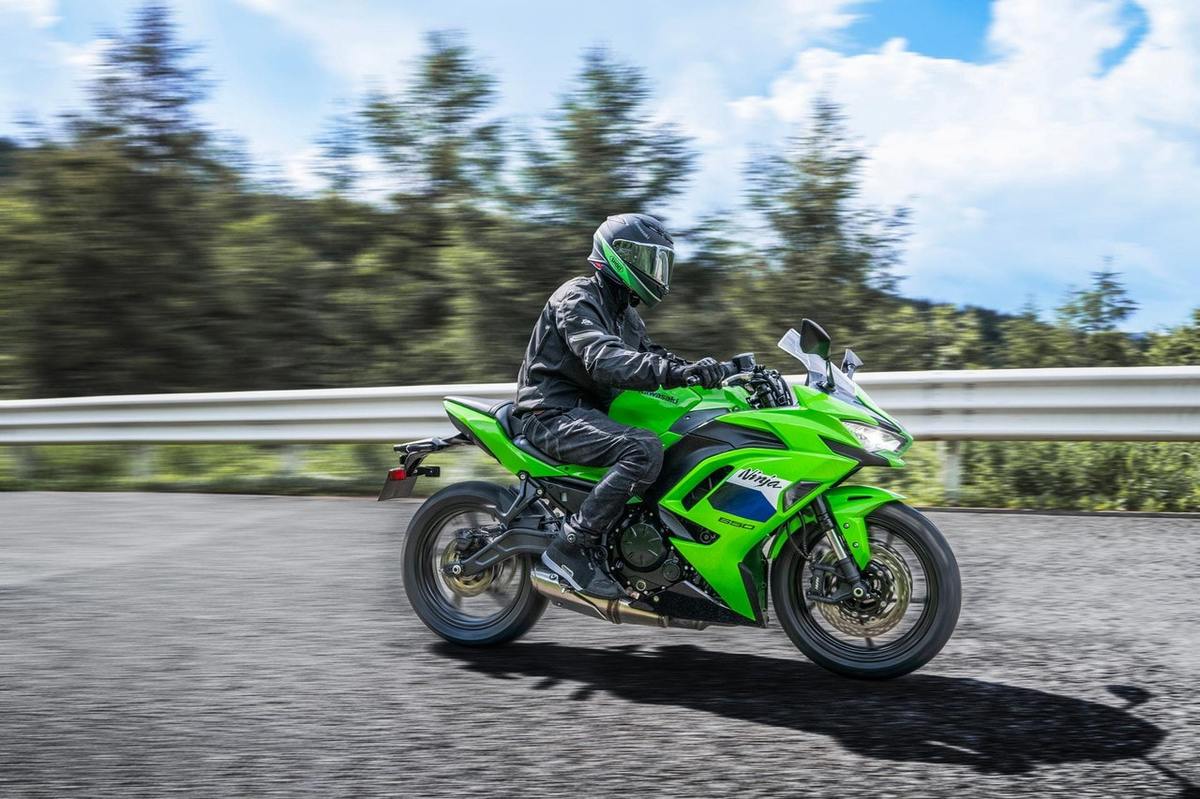

$8,099 with an inverted fork and radial brakes
The Short Answer: The 2027 Kawasaki Ninja 650 ABS is an updated version of Team Green’s 649cc parallel-twin sportbike. It adds a Showa 37mm SFF-BP inverted fork, radial-mount four-piston front calipers, a 30.9-inch seat, new TFT layouts and an accessory quickshifter. It starts at $8,099 ($8,299 special colors) plus $685 destination and arrives in late October.
The Ninja 650 is the bike I recommend to friends who want a real sportbike but would also like to keep their wrists, license and savings account. It’s friendly, light on its feet and never asks you to be a hero. The catch was always the hardware. A basic right-side-up fork and two-piston calipers did the job, but they didn’t make anybody’s heart race in the showroom.
For 2027, Kawasaki fixed exactly that. The Ninja 650 ABS gets a Showa inverted fork, radial-mount four-piston brakes, new suspension and ABS settings, a fresh instrument layout and expanded smartphone connectivity. Better yet, it costs less than last year’s model. Read that again. I’ll wait.
The update came out of the same October 13 Kawasaki 2027 lineup announcement that delivered the all-new 2027 Kawasaki Versys 900 SE LT ABS, the new KLR650 DF ABS and the KLX300 family. The Ninja 650 ABS is the middleweight sportbike update from that release, and for plenty of riders, it’s the one that matters most.
What’s New for the 2027 Kawasaki Ninja 650 ABS?
Kawasaki’s highlight list is short and to the point:
- NEW: Showa 37mm SFF-BP inverted front fork
- NEW: Radial-mount four-piston front calipers and semi-floating 300mm front discs
- UPDATED: Rear suspension settings and ABS calibration
- NEW: Low 30.9-inch seat height
- UPDATED: 4.3-inch TFT color instrument panel with two display layouts
- UPDATED: Smartphone connectivity with navigation and voice command functions
- NEW: Accessory Kawasaki Quick Shifter (KQS) for clutchless upshifts
Kawasaki calls the philosophy “Fun-Style-Easy.” I call it “don’t break what works, just make it better.”
Suspension: Showa SFF-BP Inverted Fork Up Front
The headline upgrade is the new Showa 37mm SFF-BP inverted fork, which combines Showa’s Separate Function Fork and Big Piston Fork technology. The inverted layout increases front-end rigidity, which Kawasaki says improves road-holding and gives a more planted feel up front.
That large damping piston helps the fork move smoothly at the beginning of its stroke. In plain English, that means better composure when weight pitches forward under braking and more stability on corner entry. Those are the two moments when a budget fork usually reminds you it’s a budget fork. Kawasaki says the settings keep the 650’s light, neutral handling. Front wheel travel is 4.9 inches.
Out back, the horizontal back-link rear suspension gets revised spring and damping settings to match the new fork. A reduced spring rate and optimized initial preload improve suspension action while keeping the intended chassis attitude. Spring preload is adjustable, and rear wheel travel is 5.1 inches.
Brakes: Radial Four-Piston Calipers Replace the Old Two-Pots
The previous Ninja 650’s axial-mount two-piston calipers are gone, replaced by radial-mount four-piston units. Kawasaki says the change increases rigidity around the front brake area and improves response to lever input. The lightweight calipers help keep handling nimble.
A revised front brake lever and specially selected brake pads are meant to deliver a firmer feel and linear, controllable stopping power. The dual front discs keep their 300mm diameter, but the petal-type discs are gone in favor of a semi-floating design. Out back, a single 220mm disc and single-piston caliper handle rear braking, with ABS at both ends.
Revised ABS settings provide smoother intervention. A new, wider front fender more fully covers the fork tubes, and black fork top caps finish the look. Small stuff, but it makes the bike look more expensive than it is.
Engine and Chassis: The Same Friendly 649cc Twin
The engine carries over, and I’m fine with that. It’s a 649cc liquid-cooled, DOHC, eight-valve parallel-twin with an 83.0 x 60.0mm bore and stroke and a 10.8:1 compression ratio. Kawasaki tunes it for low- to mid-range torque and smooth, natural throttle response. Fuel arrives through Kawasaki’s DFI fuel injection with dual 36mm Keihin throttle bodies. Power goes through a six-speed transmission and a sealed chain.
Kawasaki’s spec sheet claims 67.0 horsepower at 8,000 rpm and 48.5 lb-ft of torque at 6,700 rpm. That horsepower figure is measured to the ISO 4106 standard, which Kawasaki notes can read higher than an SAE measurement. Either way, this engine is about pulling cleanly out of a corner in third gear, not bench racing.
Kawasaki TRaction Control (KTRC) offers two rider-selectable modes, and an Economical Riding Indicator is there for riders who watch fuel economy as closely as lean angle.
The chassis is a lightweight, compact trellis frame built from high-tensile steel. Separate handlebars give a relatively upright riding position. Kawasaki lists a 30.9-inch seat height, down from 31.1 inches on the 2026 model, per Kawasaki’s prior-year spec sheet. It’s only 0.2 inch, but every bit helps at a stoplight.
The new hardware adds a little weight. Claimed curb weight is 427.8 pounds for the 50-state model and 425.6 pounds for the 49-state version. That’s about 2 pounds more than the 2026 Ninja 650 ABS, according to Kawasaki’s prior-year specs. Two pounds for an inverted fork and radial four-pots? I’ll take that deal and skip a second taco.
New 4.3-Inch TFT Display Layouts and Smartphone Connectivity
The 4.3-inch TFT color dash gets a new layout with two display types. Type 1 runs a bar-style tachometer across the top with vehicle info below. Type 2 uses a hexagonal tachometer. You can pick a black or white background, and brightness adjusts automatically to ambient light, with three selectable brightness levels.
Beyond speed, rpm, gear position and a shift lamp, the screen shows fuel level, consumption and remaining range, dual trip meters, average speed, coolant temperature and battery voltage. There’s also a KQS indicator, service and oil-change reminders, and call and message notifications.
RIDEOLOGY THE APP MOTORCYCLE connects wirelessly to show vehicle info, record GPS routes and riding data, and adjust some instrument settings from your phone. New for 2027, navigation functions let you see route information on your smartphone, search destinations, add waypoints and change route order. Voice command adds hands-free control of the app. Kawasaki notes that navigation and voice command require a valid license, and feature availability varies by market.
Accessory Kawasaki Quick Shifter
For the first time on the Ninja 650 ABS, you can add a Kawasaki Quick Shifter (KQS) as an accessory. It handles clutchless upshifts during acceleration. The system detects movement of the shift lever and tells the ECU to briefly cut ignition, so the next gear engages without using the clutch. KQS doesn’t work below 2,500 rpm, and Kawasaki only mentions upshifts. Accessory pricing wasn’t included in the release.
2027 Kawasaki Ninja 650 ABS Specifications
| 2027 Kawasaki Ninja 650 ABS | |
|---|---|
| Engine | 4-stroke, liquid-cooled, DOHC, 8-valve parallel-twin |
| Displacement | 649cc |
| Bore x stroke | 83.0 x 60.0mm |
| Compression ratio | 10.8:1 |
| Claimed horsepower | 67.0 hp @ 8,000 rpm (ISO 4106) |
| Claimed torque | 48.5 lb-ft @ 6,700 rpm |
| Fuel system | DFI with dual 36mm Keihin throttle bodies |
| Transmission / final drive | 6-speed / sealed chain; KQS upshifter available as accessory |
| Rider aids | KTRC (two modes), ABS, Economical Riding Indicator |
| Frame | Trellis, high-tensile steel |
| Front suspension / travel | 37mm inverted Showa SFF-BP fork / 4.9 in |
| Rear suspension / travel | Horizontal back-link, adjustable spring preload / 5.1 in |
| Front brakes | Dual 300mm semi-floating discs, radial-mount 4-piston calipers, ABS |
| Rear brake | Single 220mm disc, single-piston caliper, ABS |
| Tires | 120/70 x 17 front; 160/60 x 17 rear |
| Rake / trail | 24.0 degrees / 3.9 in |
| Wheelbase | 54.9 in |
| Length / width / height | 80.5 / 29.1 / 44.9 in |
| Ground clearance | 4.9 in |
| Seat height | 30.9 in |
| Estimated dry weight | 394.7 lb (50-state); 392.5 lb (49-state) |
| Curb weight | 427.8 lb (50-state); 425.6 lb (49-state) |
| Fuel capacity | 4.0 gal |
| Instruments | 4.3-in TFT color, two layouts; RIDEOLOGY THE APP MOTORCYCLE connectivity |
| Colors | Lime Green; Galaxy Silver; Metallic Matte Twilight Blue/Candy Persimmon Red; Metallic Flat Spark Black/Metallic Carbon Gray |
| U.S. MSRP | $8,099 standard colors; $8,299 special color and graphics (plus $685 destination) |
| Warranty | 12-month limited |
| Availability | Late October |
Price, Availability and Where It Fits
The 2027 Ninja 650 ABS starts at $8,099 for standard colors and $8,299 for the special color and graphics. Kawasaki’s U.S. site lists a $685 destination charge, which puts it at $8,784 or $8,984 before taxes and dealer fees. Availability is late October.
Here’s the part that made me double-check the PDF. Kawasaki’s 2026 release listed the Ninja 650 ABS at $8,199, so the 2027 model starts $100 lower while adding an inverted fork and radial four-piston calipers. Upgrades usually bring a price bump. This one brings a discount.
The 650 slots between the smaller Ninja 500 and the pricier middleweights. In our 2026 Kawasaki Ninja 500 Review, the little brother started at $5,400 ($5,900 with ABS) with a 41mm telescopic fork. On the other side, the bikes in our Middleweight Sportbike Shootout: 2026 Yamaha YZF-R7 vs. Suzuki GSX-8R listed at $9,199 and $9,439. The Suzuki already uses a Showa SFF-BP inverted fork, and both come with quickshifters as standard. The Ninja 650 ABS now brings similar front-end hardware for more than $1,000 less, though you give up displacement and the quickshifter costs extra.
The Bottom Line
The 2027 Kawasaki Ninja 650 ABS doesn’t try to reinvent the friendly middleweight sportbike. It keeps the easygoing 649cc twin and adds the hardware riders have wanted for years: a Showa SFF-BP inverted fork, radial four-piston brakes, retuned rear suspension and ABS, a better dash and an optional quickshifter. And it costs $100 less than last year. We’ll reserve judgment until we ride it, but on paper this is the most complete Ninja 650 yet. Look for it at dealers in late October, probably in lime green.
Related Moto-1 Reading
- 2027 Kawasaki Versys 900 SE LT ABS Adds Radar for $13,599: The all-new headliner from the same Kawasaki 2027 announcement
- 2026 Kawasaki Ninja 500 Review: The Ninja 650’s smaller, lighter sibling
- Middleweight Sportbike Shootout: 2026 Yamaha YZF-R7 vs. Suzuki GSX-8R: Two middleweight twins the Ninja 650 competes with
- 2026 Kawasaki KLE500 Real MC Commute Review: Kawasaki’s middleweight adventure twin
2027 Kawasaki Ninja 650 ABS FAQ
How much is the 2027 Kawasaki Ninja 650 ABS?
$8,099 for standard colors and $8,299 for special color and graphics, plus $685 destination.
When does the 2027 Ninja 650 ABS go on sale?
Kawasaki says it will be available in late October.
What’s new on the 2027 Ninja 650 ABS?
A Showa SFF-BP inverted fork, radial four-piston calipers, revised rear suspension and ABS, a 30.9-inch seat, new TFT layouts and an optional quickshifter.
How much horsepower does the Ninja 650 make?
Kawasaki claims 67.0 horsepower at 8,000 rpm (ISO 4106) and 48.5 lb-ft of torque at 6,700 rpm from its 649cc parallel-twin.
Does the 2027 Ninja 650 ABS have a quickshifter?
It’s available as an accessory. The Kawasaki Quick Shifter allows clutchless upshifts during acceleration and doesn’t operate below 2,500 rpm.